GEOMAGNETIC STORM: Earlier today, March 11th, the outskirts of a CME previously expected to miss Earth instead hit. The impact sparked a G2-class geomagnetic storm (now subsiding) and bright auroras around the Arctic Circle. Tour guide Marketa S. Murray photographed the display just before sunrise near Fairbanks, Alaska:

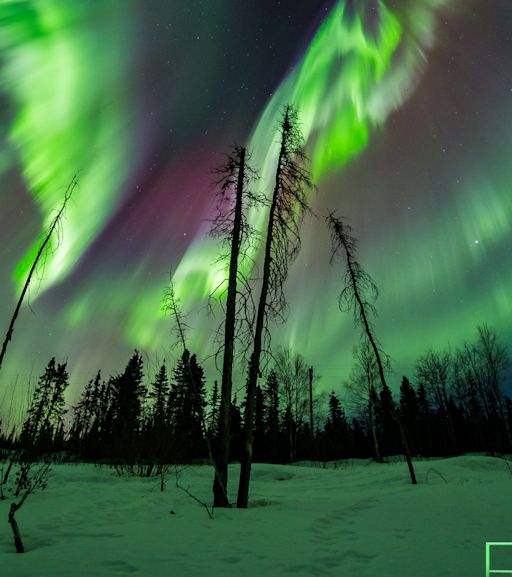
"We didn't expect to see much last night," says Murray. "Instead, it was an amazing night--all the colors you can imagine! Our guests were very happy."
This is a good time of year for auroras. For reasons that are only partially understood, geomagnetic storms favor the weeks around equinoxes; even a gentle gust of solar wind or, in this case, the sideswipe of an off-course CME can spark a good display. More lights are possible tonight as Earth moves deeper into the CME's flank. Monitor the aurora gallery for sightings. Aurora alerts: text or voice
AVIATION RADIATION EXPERIMENT--UPDATE: En route to observe the March 9th total eclipse in Indonesia, the students of Earth to Sky Calculus conducted an unusual experiment in aviation radiation. Their plane flew a great circle around the Pacific Ocean, skirting the Arctic Circle and crossing the equator in a relatively short period of time. Onboard the plane, they carried a cosmic ray balloon payload equipped with multiple radiation sensors. This allowed them to "take a snapshot" of dose rates over a wide range of latitudes. Here are some preliminary results:
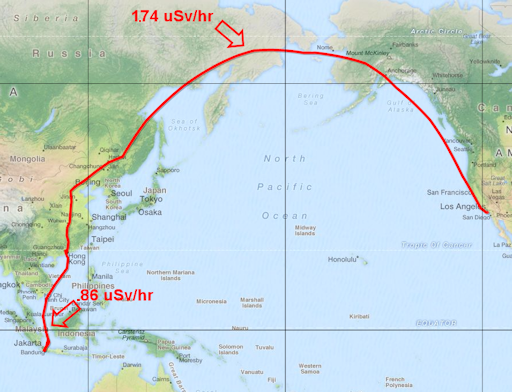
In the map, the red curve traces their flight path. Arrows point out dose rates at the highest and lowest latitudes. Throughout the trip, the plane was flying not far above 30,000 feet altitude. Students measured a 2:1 ratio of dose rates, Arctic vs. equator.
Researchers have long known that Earth's magnetic field near the equator provides a greater degree of protection against cosmic rays than Earth's magnetic field near the poles. This experiment answers the question, "How much greater?" (About 2 times.) It also builds upon Earth to Sky's ongoing study of aviation radiation which, before now, has been limited to latitudes inside the continental USA.
Radiation inside airplanes comes from deep space. Galactic cosmic rays are accelerated toward our planet by supernova explosions and other violent events in the cosmos. They penetrate the walls of aircraft with ease and have prompted the International Commission on Radiological Protection (ICRP) to classify pilots as occupational radiation workers.
The students are about to return to the United States, following approximately the same route in reverse. Will their preliminary results be confirmed? Stay tuned!
TOTAL ECLIPSE OF THE SUN: The March 9th solar eclipse is over--"and it was incredible," says Dana Crom of Earth to Sky Calculus, who witnessed the event from a beach on Belitung Island, Indonesia. "At first we thought we would not be able to see the eclipse, but morning clouds parted just in time for totality."
Indeed, all over Indonesia, observers spied the eclipse between and, more often, straight through clouds. Janne Pyykkö sends this picture from the nearby island of Terante:
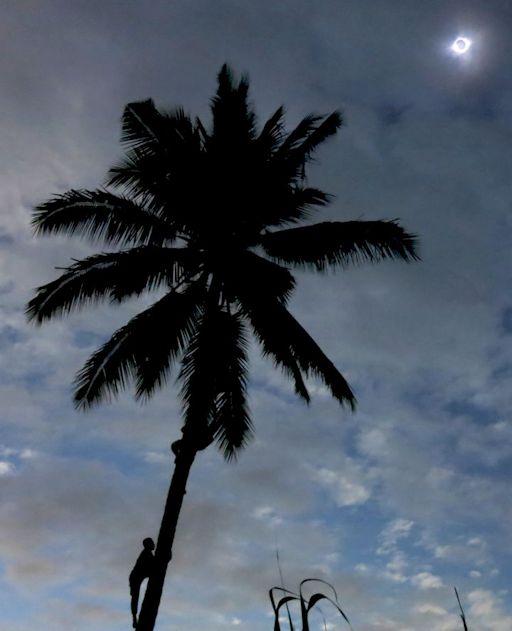
"With the help of local friends, I was able to find a coconut palm standing alone and two brave men willing to climb it for the photo," says Pyykkö. "During totality, high clouds muted the best sky colors. Even so, it was a fantastic experience."
On Belitung Island, Earth to Sky Calculus student Ginger Perez recorded a must-see video of totality. (Turn up the volume to hear the reaction of the crowd and the sound of ocean waves.) "It was hot when the sun rose this morning," says Ginger, "but the temperature dropped when the shadow of the Moon swept over us. It felt so nice! The slight ocean breeze made the eclipse sweeter still."
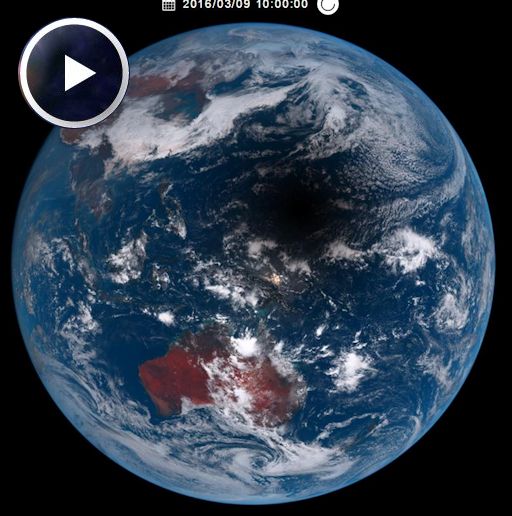
Japan's Sunflower-8 meteorological satellite saw the Moon's shadow from Earth orbit. Here it is racing across the Pacific on March 9th:
When the shadow engulfed Ternate, Indonesia, "the temperature dropped from 91.3F to 82.5F and the humidity increased from 73% to 85%," reports photographer Donald S. Gardner. "Roosters were crowing after totality."
Meanwhile, 30,000 feet above the Pacific, Alaska Airlines flight 870 from Anchorage to Honolulu diverted to fly through the path of totality. "I took photos every 2 seconds beginning 2 minutes before totality and ending 2 minutes after totality," reports passenger Evan Zucker who, fortunately, had a window seat:
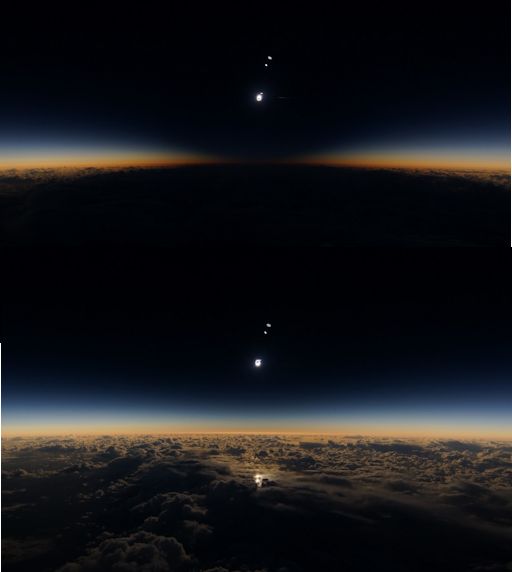
The top frame shows the view from the plane as it crossed the middle of the Moons shadow. The bottom frame shows light returning to the cloudtops as the plane began to exit. More of Zucker's airborne photos may be found here.
Browse the photo gallery for more tales from the eclipse zone:
Realtime Spaceweather Photo Gallery
Realtime Spaceweather Photo Gallery