WEAKLY FLARING: Two sunspots (AR2513 and AR2519) are crackling with minor C-class solar flares. Otherwise, solar activity is very low. NOAA forecasters say there is no more than a 1% chance of stronger flares this weekend. The plunge toward Solar Minimum continues.... Aurora alerts: text or voice
AURORAS OVERHEAD: Yesterday, March 11th, an unexpected CME sideswiped Earth's magnetic field, sparking a G2-class geomagnetic storm. At the peak of the storm, Martin Guth of Fairbanks, Alaska, looked up and saw this:

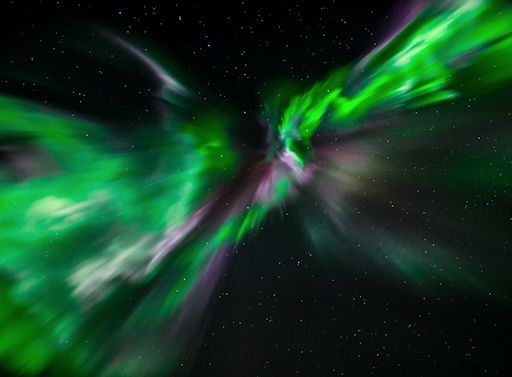
"This was the most impressive auroral event I have ever witnessed," says Guth, "and although it was short, it made up for it via intensity!"
This is a good time of year for auroras. For reasons that are only partially understood, geomagnetic storms favor the weeks around equinoxes; even a gentle gust of solar wind can spark a good display. More lights are possible this weekend as Earth moves deeper into the wake of the CME. NOAA forecasters estimate a 30% chance of additional geomagnetic storms on March 12th. Aurora alerts: text or voice
VAN GOGH CLOUDS: Peter Lowenstein lives in Mutare, Zimbabwe. For a few minutes on Friday, March 11th, he felt as if he were transported from Africa into a painting by Vincent van Gogh. "Just before sunset," says Lowenstein, "a thin band of wavy clouds developed above a cumulonimbus anvil and became iridescent." He snapped this picture:
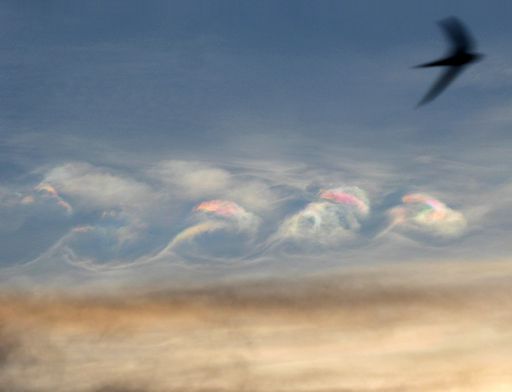
These clouds, sometimes called "billow clouds," are produced by the Kelvin-Helmholtz instability when horizontal layers of air brush by one another at different velocities. It is widely believed that these waves in the sky inspired the swirls in van Gogh's masterpiece The Starry Night.
The delicate pastel colors of the waves come from irridescence--the diffraction of sunlight by tiny water droplets in the clouds. As the sun set, the colors faded to gray, returning Lowenstein to his porch in Zimbabwe.
More photos that can transport you to strange and beautiful places may be found in the realtime gallery:
Realtime Spaceweather Photo Gallery
AVIATION RADIATION EXPERIMENT--UPDATE: En route to observe the March 9th total eclipse in Indonesia, the students of Earth to Sky Calculus conducted an unusual experiment in aviation radiation. Their plane flew a great circle around the Pacific Ocean, skirting the Arctic Circle and crossing the equator in a relatively short period of time. Onboard the plane, they carried a cosmic ray balloon payload equipped with multiple radiation sensors. This allowed them to "take a snapshot" of dose rates over a wide range of latitudes. Here are some preliminary results:

In the map, the red curve traces their flight path. Arrows point out dose rates at the highest and lowest latitudes. Throughout the trip, the plane was flying not far above 30,000 feet altitude. Students measured a 2:1 ratio of dose rates, Arctic vs. equator.
Researchers have long known that Earth's magnetic field near the equator provides a greater degree of protection against cosmic rays than Earth's magnetic field near the poles. This experiment answers the question, "How much greater?" (About 2 times.) It also builds upon Earth to Sky's ongoing study of aviation radiation which, before now, has been limited to latitudes inside the continental USA.
Radiation inside airplanes comes from deep space. Galactic cosmic rays are accelerated toward our planet by supernova explosions and other violent events in the cosmos. They penetrate the walls of aircraft with ease and have prompted the International Commission on Radiological Protection (ICRP) to classify pilots as occupational radiation workers.
The students are now returning to the United States, following approximately the same route in reverse. Will their preliminary results be confirmed? Stay tuned!
Realtime Spaceweather Photo Gallery