CO-ROTATING INTERACTION REGION: NOAA forecasters estimate a 60% chance of polar geomagnetic storms on March 16th when a co-rotating interaction region (CIR) is expected to hit Earth's magnetic field. CIRs are transition zones between slow- and fast-moving solar wind streams. Solar wind plasma piles up in these regions, producing density gradients and shock waves that do a good job of sparking auroras. Aurora alerts: text or voice
THE GHOSTLY CORONA, REVEALED: One of the great attractions of a total eclipse is the chance to see something usually invisible to the human eye: the sun's ghostly corona. Normally overwhelmed by the glare of the solar disk, the gossamer outer atmosphere of our star reveals itself only when the Moon intervenes. On March 9th in Indonesia, it revealed itself in richly-textured detail:

This remarkable picture was taken by a team of undergraduate researchers observing the total eclipse from Tanjung Pandan (Belitung Island). Matt Penn of the National Solar Observatory in Tucson, Arizona, explains:
"In preparation for the 2017 'Great American Eclipse,' and to train some undergraduates who will be in the path of that event, we sent 5 teams to Indonesia with the equipment we hope to use next year in the USA. The goal was to take white light coronal images at high cadence. This first-look image from one of the sites shows that we succeeded."
Studying the corona is important because it is a primary source of space weather. The solar wind emerges from the corona, as do coronal mass ejections (CMEs), which can spark strong geomagnetic storms when they hit Earth.
Spacecraft such as STEREO and SOHO are equipped with coronagraphs that block the sun's glare; but no man-made coronagraph is as good as the Moon. "The field of view of space coronagraphs does not include the lower regions of the corona, becase blocking the sun is difficult in the presence of spacecraft jitter," says Penn. "That's why we love solar eclipses."
"One of our science targets is the dynamics of the polar plumes above the north and south coronal holes," Penn continues. "There is evidence that in these denser regions there are periodic or quasi-periodic enhancements which propagate outward from the sun."
"The undergraduate students involved in this project are Sarah Kovac, Logan Jensen, Honor Hare and Myles McKay," says Penn."Their mentors are Bob Baer, Michael Pierce, Richard Gelderman and Don Walter. None of this team had ever seen a solar eclipse before, and none of the students had ever traveled outside the USA. Now they are returning with world-class observations of the solar corona. Congratulations!"
March 9th Solar Eclipse Photo Gallery
VAN GOGH CLOUDS: Peter Lowenstein lives in Mutare, Zimbabwe. For a few minutes last Friday, he felt as if he were transported from Africa into a painting by Vincent van Gogh. "Just before sunset," says Lowenstein, "a thin band of wavy clouds developed above a cumulonimbus anvil and became iridescent." He snapped this picture:
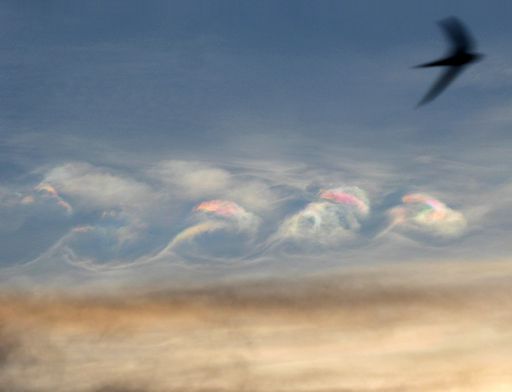
These clouds, sometimes called "billow clouds," are produced by the Kelvin-Helmholtz instability when horizontal layers of air brush by one another at different velocities. It is widely believed that these waves in the sky inspired the swirls in van Gogh's masterpiece The Starry Night.
The delicate pastel colors of the waves come from irridescence--the diffraction of sunlight by tiny water droplets in the clouds. As the sun set, the colors faded to gray, returning Lowenstein to his porch in Zimbabwe.
More photos that can transport you to strange and beautiful places may be found in the realtime gallery:
Realtime Spaceweather Photo Gallery
AURORAS OVERHEAD: On Friday, March 11th, an unexpected CME sideswiped Earth's magnetic field, sparking a G2-class geomagnetic storm. At the peak of the storm, Martin Guth of Fairbanks, Alaska, looked up and saw this:

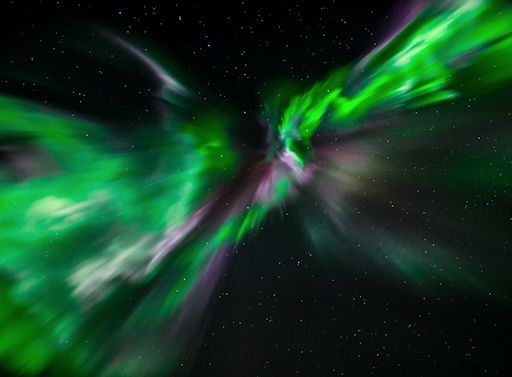
"This was the most impressive auroral event I have ever witnessed," says Guth, "and although it was short, it made up for it via intensity!"
This is a good time of year for auroras. For reasons that are only partially understood, geomagnetic storms favor the weeks around equinoxes; even a gentle gust of solar wind can spark a good display. More lights are possible this weekend as Earth moves deeper into the wake of the CME. NOAA forecasters estimate a 25% chance of additional geomagnetic storms on March 13th. Aurora alerts: text or voice
AVIATION RADIATION EXPERIMENT--UPDATE: En route to observe the March 9th total eclipse in Indonesia, the students of Earth to Sky Calculus conducted an unusual experiment in aviation radiation. Their plane flew a great circle around the Pacific Ocean, skirting the Arctic Circle and crossing the equator in a relatively short period of time. Onboard the plane, they carried a cosmic ray balloon payload equipped with multiple radiation sensors. This allowed them to "take a snapshot" of dose rates over a wide range of latitudes. Here are some preliminary results:

In the map, the red curve traces their flight path. Arrows point out dose rates at the highest and lowest latitudes. Throughout the trip, the plane was flying not far above 30,000 feet altitude. Students measured a 2:1 ratio of dose rates, Arctic vs. equator.
Researchers have long known that Earth's magnetic field near the equator provides a greater degree of protection against cosmic rays than Earth's magnetic field near the poles. This experiment answers the question, "How much greater?" (About 2 times.) It also builds upon Earth to Sky's ongoing study of aviation radiation which, before now, has been limited to latitudes inside the continental USA.
Radiation inside airplanes comes from deep space. Galactic cosmic rays are accelerated toward our planet by supernova explosions and other violent events in the cosmos. They penetrate the walls of aircraft with ease and have prompted the International Commission on Radiological Protection (ICRP) to classify pilots as occupational radiation workers.
The students are now returning to the United States, following approximately the same route in reverse. Will their preliminary results be confirmed? Stay tuned!
Realtime Spaceweather Photo Gallery