CIR HITS EARTH, SPARKS AURORAS: Pi Day ended with an explosion of color. During the late hours of March 14th (3.14), a co-rotating interaction region (CIR) hit Earth's magnetic field, sparking bright auroras around the Arctic Circle. Sarah Skinner photographed the display from Abisko, Sweden:

"After a rainy day, the clouds broke. Nothing could have prepared me for the colors I was then about to witness!!" says Skinner. "As the aurora developed the most intense reds I have ever seen appeared. Reds, purples, greens, so many colors; I could not believe what I was seeing."
CIRs are transition zones between slow- and fast-moving solar wind streams. Solar wind plasma piles up in these regions, producing density gradients and shock waves that tend to ignite auroras when they strike Earth's magnetic field.
The CIR has passed, but more lights are in the offing. Earth is moving into a stream of high-speed solar wind following behind the CIR. In response, NOAA forecasters say there is a 65% chance of polar geomagnetic storms on March 15th. Aurora alerts: text or voice
COMET BRIGHTENS AS IT APPROACHES EARTH: On March 21st, Comet 252P/LINEAR will make a close approach to Earth--only 0.036 AU (5.4 million km) away. This is the fifth closest cometary approach on record and, as a result, the normally dim comet could become an easy target for backyard telescopes. In fact, it is brightening much faster than expected: data. "Comet 252P/LINEAR has surpassed expectations and is now bordering on naked eye visibility for southern observers," reports Michael Mattiazzo of Swan Hill, Victoria, Australia, who took this picture on March 13th:
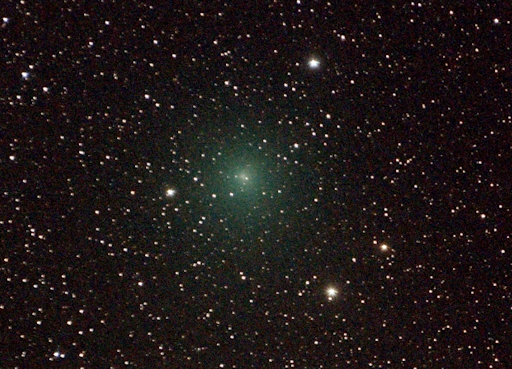
"Since March 7th, the comet has brightened about 0.5 magnitudes per day," continues Mattiazzo, "and now it is near 6th magnitude. The comet's atmosphere (coma) is expanding rapidly, too, from 10 arcminutes on March 7th to 35 arcminutes on March 14th. It may reach 1o across by March 21st."
This is a southern hemisphere event. At closest approach on March 21st, the brightening comet will speed through the constellations Triangulum Australis and Apus. Observers south of the equator can use this ephemeris to point their telescopes. In remote places with very dark skies, it is possible that no telescope will be required; naked eyes might suffice. Stay tuned for updates as the comet approaches.
THE GHOSTLY CORONA, REVEALED: One of the great attractions of a total eclipse is the chance to see something usually invisible to the human eye: the sun's ghostly corona. Normally overwhelmed by the glare of the solar disk, the gossamer outer atmosphere of our star reveals itself only when the Moon intervenes. On March 9th in Indonesia, it revealed itself in richly-textured detail:

This remarkable picture was taken by a team of undergraduate researchers observing the total eclipse from Tanjung Pandan (Belitung Island). Matt Penn of the National Solar Observatory in Tucson, Arizona, explains:
"In preparation for the 2017 'Great American Eclipse,' and to train some undergraduates who will be in the path of that event, we sent 5 teams to Indonesia with help from NASA funding with the equipment we hope to use next year in the USA. The goal was to take white light coronal images at high cadence. This first-look image from one of the sites shows that we succeeded."
Studying the corona is important because it is a primary source of space weather. The solar wind emerges from the corona, as do coronal mass ejections (CMEs), which can spark strong geomagnetic storms when they hit Earth.
Spacecraft such as STEREO and SOHO are equipped with coronagraphs that block the sun's glare; but no man-made coronagraph is as good as the Moon. "The field of view of space coronagraphs does not include the lower regions of the corona, becase blocking the sun is difficult in the presence of spacecraft jitter," says Penn. "That's why we love solar eclipses."
"One of our science targets is the dynamics of the polar plumes above the north and south coronal holes," Penn continues. "There is evidence that in these denser regions there are periodic or quasi-periodic enhancements which propagate outward from the sun."
"The undergraduate students involved in this project are Sarah Kovac, Logan Jensen, Honor Hare and Myles McKay," says Penn."Their mentors are Bob Baer, Michael Pierce, Richard Gelderman and Don Walter. None of this team had ever seen a solar eclipse before, and none of the students had ever traveled outside the USA. Now they are returning with world-class observations of the solar corona. Congratulations!"
March 9th Solar Eclipse Photo Gallery