GREEN COMET APPROACHES EARTH: On March 21st, Comet 252P/LINEAR will make a close approach to Earth--only 0.036 AU (5.4 million km) away. This is the fifth closest cometary approach on record and, as a result, the normally dim comet has become an easy target for backyard telescopes. Indeed, it is brightening much faster than expected.
"Comet 252P/LINEAR has surpassed expectations and is now bordering on naked eye visibility for southern observers," reports Michael Mattiazzo of Swan Hill, Australia. "At the moment it is near magnitude +6," Observing from Brisbane, Australia, Tom Harradine didn't even need a telescope to photograph 252P/LINEAR. On March 17th, he caught the green comet (circled) passing by the Tarantula Nebula using just a digital camera:
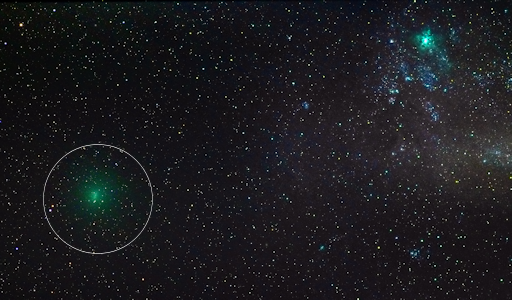
"This image is a stack of 140 four second exposures I made using a Canon EOS 70D set at f/4.0, ISO 12800, and 200mm," he says.
The comet is green because its vaporizing nucleus emits diatomic carbon, C2, a gas which glows green in the near-vacuum of space. The verdant color will become more intense in the nights ahead as 252P/LINEAR approaches Earth.
In recent days, astronomers have realized that Comet 252P/LINEAR might have a companion. A smaller and much dimmer comet named "P/2016 BA14" will buzz Earth even closer than 252P/LINEAR on March 22nd. P/2016 BA14 appears to be a fragment of 252P/LINEAR. Unlike its parent, however, P/2016 BA14 is "pitifully faint" and difficult to observe. Sky and Telescope has the full story.
There is a chance that the comet's approach could cause a minor meteor shower. According to the International Meteor Organization, "[modeling by forecaster] Mikhail Maslov indicates that there might be a weak episode of faint, very slow meteors (15.5 km/s) on March 28–30 from a radiant near the star μ Leporis." Little is known about meteors from this comet, so estimates of the meteor rate are very uncertain. Maslov's models suggest no more than 5 to 10 per hour.
This is a southern hemisphere event. At closest approach on March 21st, 252P/LINEAR will speed through the constellations Triangulum Australis and Apus, far south of the celestial equator. Observers can use this ephemeris to point their cameras and telescopes.
Realtime Comet Photo Gallery
[Resources: brightness measurements, 3D orbit, orbital elements]
SOLAR WIND SPARKS AURORAS: For the past three days, a stream of solar wind has been buffeting Earth's magnetic field, causing intermittent G1-class geomagnetic storms around the Arctic Circle. On March 15th, Didier Van Hellemont of Luosto, Finland, looked up at just the right moment and saw this:

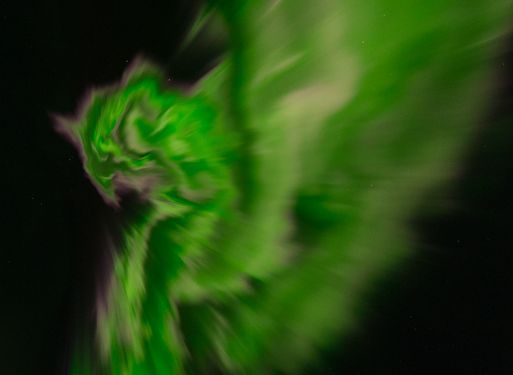
This is called a "corona"--a spray of colorful lights seen by observers who look straight up into the folds of auroral curtains. "There were no less than 6 corona events that night!" says Van Hellemont. "This spectacular specimen showed a lot of movement. It was fantastic."
The stream of solar wind which caused the display has been especially effective at sparking auroras. The reason: Magnetic fields inside the stream have a negative polarity. This means they can link to Earth's magnetic field, opening a crack in our planet's magnetosphere and allowing solar wind inside. Auroras inevitably follow.
NOAA forecasters estimate a 50% chance of additional G1-class geomagnetic storms on March 17th as the solar wind continues to blow. Aurora alerts: text or voice
A SPHERICAL VIEW OF THE SOLAR ECLIPSE: Eight days ago, the students of Earth to Sky Calculus stood on a beach in Indonesia waiting for the cool shadow of the Moon to sweep over the white sands of Belitung Island. They were there to test cameras for high-altitude ballooning--specifically, the Solar Eclipse Balloon Network. One of those cameras had a spherical lens, able to see in all directions at once. Here is how it viewed the students setting up their experiment on the beach:
On the beach at Belitung Island, Indonesia. - Spherical Image - RICOH THETA
We already know that this camera, a Ricoh Theta S, can operate at the edge of space. It traveled there in late February and took spectacular pictures of the stratosphere. But could it photograph a total eclipse of the sun? The answer is "yes."
Minutes after the first picture was taken, the shadow of the Moon engulfed Belitung Island, and the Ricoh did a great job capturing the alien twilight. Click here to transport yourself to the path of totality.
March 9th Solar Eclipse Photo Gallery