QUIET SUN: The sun is peppered with sunspots. However, they are all relatively small and none has the type of unstable magnetic field that is likely to explode. As a result, solar activity is very low and likely to remain so for days to come. NOAA forecasters say there is no more than a 5% chance of any strong solar flares this weekend. Aurora alerts: text or voice
SPRING IS AURORA SEASON: Northern Spring has arrived. To know this is true, one only has to look at the night sky over Alaska. Why? Because Spring is aurora season. Dirk Obudzinski sends this picture, taken March 19th, from Fox, Alaska:
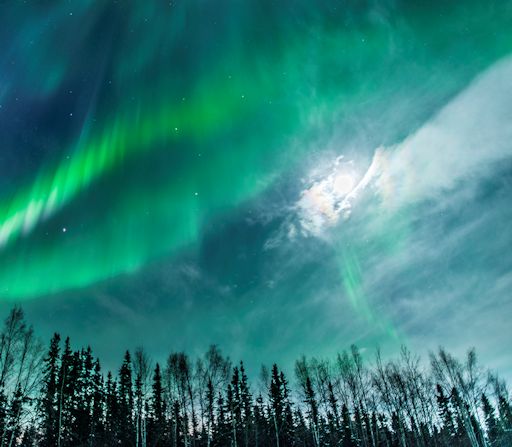
"The auroras were brighter than the surrounding moonlit clouds," says Obudzinski. "It was a fantastic display despite most geomagnetic predictions signaling quiet conditions for last night. You just never know!"
Indeed, this is the time of year when you just never know. For reasons that are only partially understood, the weeks around equinoxes favor geomagnetic storms. Even a gentle gust of solar wind can spark a magnificent display. Stay tuned to the photo gallery for more Spring Green.
GREEN AIRGLOW OVER THE ATACAMA DESERT: Not all green lights in the sky are auroras. Yuri Beletsky discovered this for himself on March 18, 2016, when he looked up from the Atacama desert of Chile:
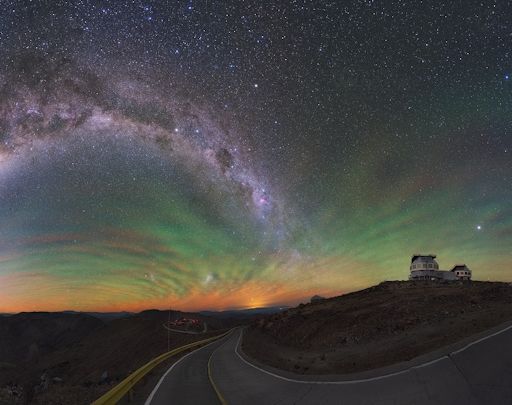
The green light is called "airglow." Airglow is a luminous bubble that surounds our entire planet, fringing the top of the atmosphere with aurora-like color. Although airglow resembles the aurora borealis, its underlying physics is different. Airglow is caused by an assortment of chemical reactions in the upper atmosphere driven mainly by solar ultraviolet radiation; auroras, on the other hand, are ignited by gusts of solar wind.
"The sky was literally shining due to quite intense airglow and we were really lucky to witness it," says Beletsky. "It was so strong that one could hardly see Magellanic clouds through those colorful emissions. In my photo, the domes of the 6.5-m Magellan telescopes are on in the right."
Green airglow is best photographed from extremely dark sites on nights when the Moon is new or below the horizon. It often shows up in long exposures of the Milky Way. Browse the gallery for more examples:
Realtime Airglow Photo Gallery
COMET (and FRAGMENTS) APPROACH EARTH: On March 21st, green comet 252P/LINEAR will fly by Earth only 5.4 million km away-- the fifth closest cometary approach on record. One day later, a suspected fragment of the comet will pass even closer (3 million km). The name of the fragment is "P/2016 BA14," and Gregg Ruppel has photographed it zipping among the stars over Animas, New Mexico, on March 18th. Click to view a 40-minute time lapse video:
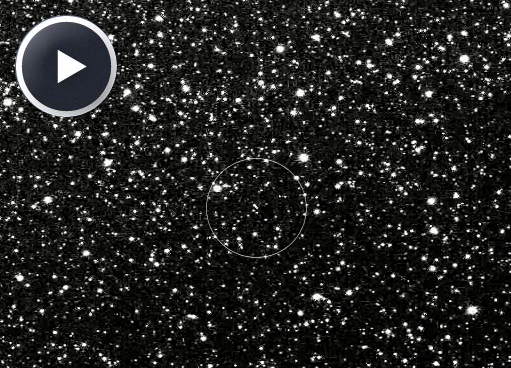
"I observed P/2016 BA14 using a 10-inch telescope and a STL11000 deep-sky CCD camera," says Ruppel.
By all accounts, the comet fragment is "pitifully faint." The parent comet, however, is relatively bright. Indeed, it is now on the threshold of naked eye visibility for observers in the southern hemisphere. Last night, Gerald Rhemann had little trouble photographing the 252P/LINEAR's green atmosphere from his backyard observatory in Namibia, Africa:
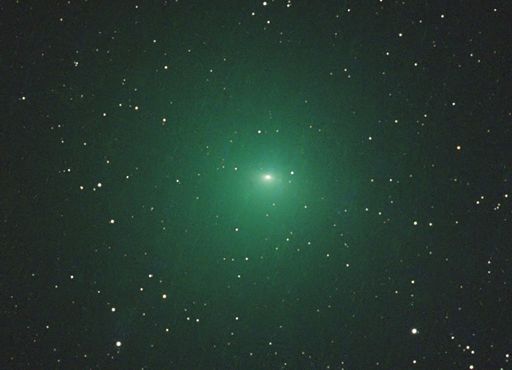
"I used a 12-inch telescope for this 360-second color exposure," says Rhemann.
The comet is green because its vaporizing nucleus emits diatomic carbon, C2, a gas which glows green in the near-vacuum of space. The verdant color will become even more intense in the nights ahead as 252P/LINEAR approaches Earth.
There is a chance that the comet's approach could cause a minor meteor shower. According to the International Meteor Organization, "[modeling by forecaster] Mikhail Maslov indicates that there might be a weak episode of faint, very slow meteors (15.5 km/s) on March 28–30 from a radiant near the star μ Leporis." Little is known about meteors from this comet, so estimates of the meteor rate are very uncertain. Maslov's models suggest no more than 5 to 10 per hour.
Realtime Comet Photo Gallery
[Resources: brightness measurements, 3D orbit, orbital elements]