BRIGHT LIGHTS IN THE EVENING SKY: When the sun goes down tonight, step outside and look east. You'll see Jupiter and the Moon rising together only a few degrees apart. It's a beautiful conjunction, and a great way to end the day. [sky map]

EQUINOX SOLAR WIND: A large hole has formed in the atmosphere above the sun's north pole, and it is spewing solar wind into space. NASA's Solar Dynamics Observatory is monitoring the opening, colored deep-blue in the extreme ultraviolet image taken on March 21st:

This type of atmospheric hole is called a "coronal hole." Coronal holes are places where the sun's magnetic field opens up and allows solar wind to escape. In the image above, the flow of solar wind plasma is traced by white arrows.
A stream of solar wind flowing from this coronal hole will likely reach Earth on March 22-23. Because of the hole's northern latitude on the sun, the emerging stream might not hit Earth directly. Instead, it could sail mostly north of our planet and only deliver a glancing blow to Earth's magnetic field.
Good news for sky watchers: At this time of year, a glancing blow can be enough to spark bright auroras. For reasons that are only partially understood, the weeks around equinoxes favor geomagnetic storms. Even a gentle gust of solar wind can produce a magnificent display. Monitor the photo gallery for sightings. Aurora alerts: text or voice
PLANT YOUR OWN SPACE GARDEN: Northern spring has arrived, and that means it's time to plant flowers. Mutant space flowers, that is. These Zinnia seeds flew to the edge of space aboard an Earth to Sky Calculus helium balloon on Feb. 17, 2016:
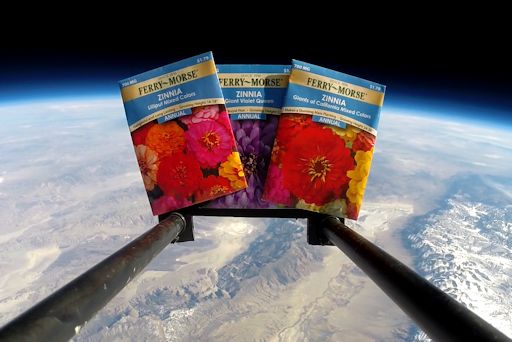
En route, the seeds were exposed to comic ray doses more than 100x Earth normal, temperatures as low as -63C, and air pressures only 0.3% of sea level.
Zinnias are interesting because they have recently blossomed on the International Space Station. Maybe it's time to plant these space flowers in your garden, too. For $49.95 you can have some. Each order comes with one seed packet flown to the edge of space, and a second seed packet that was kept on Earth as a control sample. Plant them side by side to discover the effect of near-space flight on your flowers. All proceeds support student research.
Speaking of mutants, we have also flown sunflower seeds to the edge of space, where they soaked up cosmic rays for more than 2 hours. What happens when you plant such seeds? Spaceweather.com reader Christian Schwarze bought some and found out. "A second flower grew out of the side of the first one," he says. "Very strange!"

"Unfortunately, we were on holiday while it flowered," says Schwarze.
Readers who wish to repeat these experiments in their own backyard may order sunflowers, zinnias, and many other stratospheric seeds from Earth to Sky Calculus.
COMET (and FRAGMENTS) APPROACH EARTH: On March 21st, green comet 252P/LINEAR will fly by Earth only 5.4 million km away-- the fifth closest cometary approach on record. One day later, a suspected fragment of the comet will pass even closer (3 million km). The name of the fragment is "P/2016 BA14," and Gregg Ruppel has photographed it zipping among the stars over Animas, New Mexico, on March 18th. Click to view a 40-minute time lapse video:
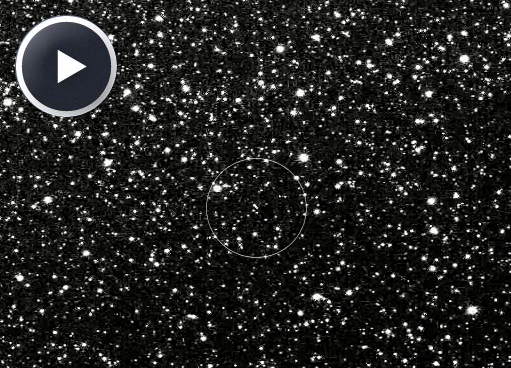
"I observed P/2016 BA14 using a 10-inch telescope and a STL11000 deep-sky CCD camera," says Ruppel.
By all accounts, the comet fragment is "pitifully faint." The parent comet, however, is relatively bright. Indeed, it is now on the threshold of naked eye visibility for observers in the southern hemisphere. Last night, Gerald Rhemann had little trouble photographing the 252P/LINEAR's green atmosphere from his backyard observatory in Namibia, Africa:
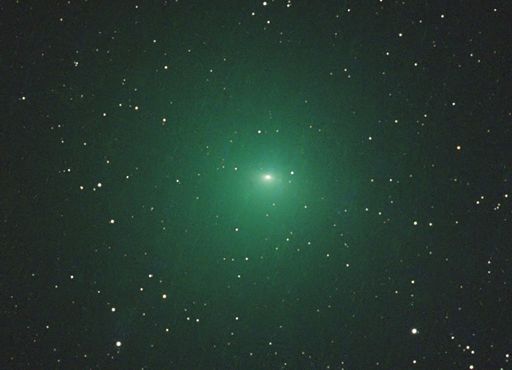
"I used a 12-inch telescope for this 360-second color exposure," says Rhemann.
The comet is green because its vaporizing nucleus emits diatomic carbon, C2, a gas which glows green in the near-vacuum of space. The verdant color will become even more intense in the nights ahead as 252P/LINEAR approaches Earth.
There is a chance that the comet's approach could cause a minor meteor shower. According to the International Meteor Organization, "[modeling by forecaster] Mikhail Maslov indicates that there might be a weak episode of faint, very slow meteors (15.5 km/s) on March 28–30 from a radiant near the star μ Leporis." Little is known about meteors from this comet, so estimates of the meteor rate are very uncertain. Maslov's models suggest no more than 5 to 10 per hour.
Realtime Comet Photo Gallery
[Resources: brightness measurements, 3D orbit, orbital elements]