FULL WORM MOON: There's a full Moon tonight and according to folklore it has a special name. The "Worm Moon" heralds the coming of northern Spring and the first stirrings of earthworms in dormant winter gardens. Robins benefit most from this turn of events, but Night Owls enjoy it, too. Step outside after dark and enjoy the Spring moonlight. [photo gallery]
EQUINOX SOLAR WIND: A large hole has formed in the atmosphere above the sun's north pole, and it is spewing solar wind into space. NASA's Solar Dynamics Observatory is monitoring the opening, colored deep-blue in the extreme ultraviolet image taken on March 21st:

This type of atmospheric hole is called a "coronal hole." Coronal holes are places where the sun's magnetic field opens up and allows solar wind to escape. In the image above, the flow of solar wind plasma is traced by white arrows.
A stream of solar wind flowing from this coronal hole will likely reach Earth on March 22-23. Because of the hole's northern latitude on the sun, the emerging stream might not hit Earth directly. Instead, it could sail mostly north of our planet and only deliver a glancing blow to Earth's magnetic field.
Good news for sky watchers: At this time of year, a glancing blow can be enough to spark bright auroras. For reasons that are only partially understood, the weeks around equinoxes favor geomagnetic storms. Even a gentle gust of solar wind can produce a magnificent display. Monitor the photo gallery for sightings. Aurora alerts: text or voice
PLANT YOUR OWN SPACE GARDEN: Northern spring has arrived, and that means it's time to plant flowers. Mutant space flowers, that is. These Zinnia seeds flew to the edge of space aboard an Earth to Sky Calculus helium balloon on Feb. 17, 2016:
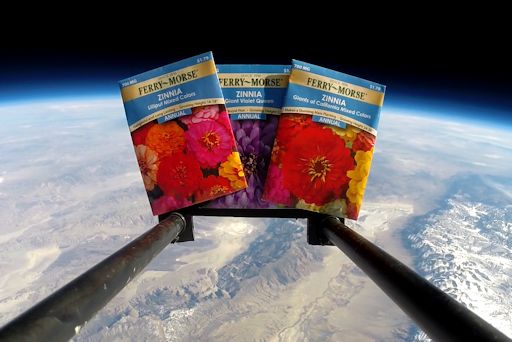
En route, the seeds were exposed to comic ray doses more than 100x Earth normal, temperatures as low as -63C, and air pressures only 0.3% of sea level.
Zinnias are interesting because they have recently blossomed on the International Space Station. Maybe it's time to plant these space flowers in your garden, too. For $49.95 you can have some. Each order comes with one seed packet flown to the edge of space, and a second seed packet that was kept on Earth as a control sample. Plant them side by side to discover the effect of near-space flight on your flowers. All proceeds support student research.
Speaking of mutants, we have also flown sunflower seeds to the edge of space, where they soaked up cosmic rays for more than 2 hours. What happens when you plant such seeds? Spaceweather.com reader Christian Schwarze bought some and found out. "A second flower grew out of the side of the first one," he says. "Very strange!"
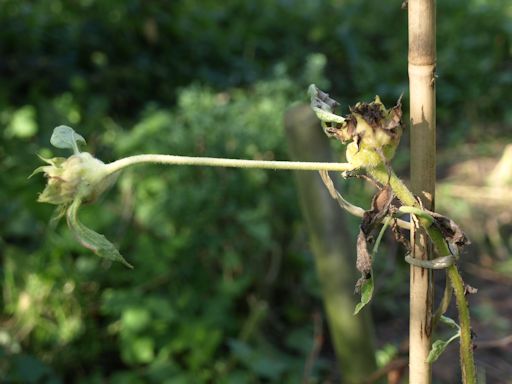
"Unfortunately, we were on holiday while it flowered," says Schwarze.
Readers who wish to repeat these experiments in their own backyard may order sunflowers, zinnias, and many other stratospheric seeds from Earth to Sky Calculus.
Realtime Spaceweather Photo Gallery