SOLAR ACTIVITY RISES TO A NEW LOW: Lately, the sun has been so quiet that even a minor solar flare would attract attention. On March 23rd, such a flare occured. Sunspot AR2524 unleashed a C1-class explosion. According to NOAA scales of space weather, this raised solar activity from "very low" to "low." What the flare lacked in intensity, however, it made up for in beauty. Watch this movie from NASA's Solar Dynamics Observatory. Solar flare alerts: text or voice
MYSTERIOUS BRIGHT SPOTS ON CERES: Last year, NASA's Dawn spacecraft went into orbit around Ceres, a dwarf planet in the asteroid belt. Immediately, researchers were mesmerized by a number of bright spots peppering the planet's charcoal-gray surface. What were they? No one knew, but they hoped that close-up images taken during a low orbit in Feb. 2016 might crack the mystery. Yesterday, those images were released, and here is an example:

This is the largest bright spot on Ceres, located at the center of Occator Crater. Dawn took the picture at point-blank range, just 240 miles (385 kilometers) above the crater's floor. By far the best photo ever taken of a bright spot on Ceres, it reveals a dome criss-crossed by numerous linear features and fractures.
It does not, however, solve the mystery. "The intricate geometry of the crater interior suggests geologic activity in the recent past, but we will need to complete detailed geologic mapping of the crater in order to test multiple hypotheses for its formation," says Ralf Jaumann of the German Aerospace Center. He is a member of the Dawn science team that released the new images at the 47th annual Lunar and Planetary Science Conference in The Woodlands, Texas, on March 22nd.
One idea which is gaining favor is that the bright area might be a crust of salt marking the spot where a briny underground ocean briefly broke through to the surface. If so, Ceres might not be as dry as it looks. Indeed, the density of Ceres suggests that 1/3rd of the mass of the dwarf planet is H2O, and some researchers think Ceres contains more freshwater than Earth itself. Sounds like a mystery worth solving.... For more information about the Dawn mission, visit NASA.gov.
AURORA BREATHING DRAGON: Last night at the Chena Hot Springs in Alaska, Todd Salat witnessed something rare: "An aurora-breathing dragon," he says. "It appeared during another unbelievable March display of Northern Lights." Unbelievable? Here's the proof:

"I watched the show along with a multinational group of aurora enthusiasts, who literally howled at the lights overhead," says Salat. "It was a blast of fresh air and even the local dragon sculpture was puffing cool breaths of green light toward the Moon."
The show's not over. A solar wind stream is expected to brush against Earth's magnetic field later today, sparking another episode of polar auroras. NOAA forecasters estimate a 35% chance of G1-class geomagnetic storms on March 23rd. Aurora alerts: text or voice

PLANT YOUR OWN SPACE GARDEN: Northern spring has arrived, and that means it's time to plant flowers. Mutant space flowers, that is. These Zinnia seeds flew to the edge of space aboard an Earth to Sky Calculus helium balloon on Feb. 17, 2016:
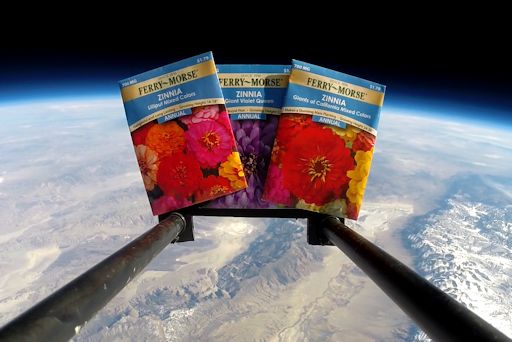
En route, the seeds were exposed to comic ray doses more than 100x Earth normal, temperatures as low as -63C, and air pressures only 0.3% of sea level.
Zinnias are interesting because they have recently blossomed on the International Space Station. Maybe it's time to plant these space flowers in your garden, too. For $49.95 you can have some. Each order comes with one seed packet flown to the edge of space, and a second seed packet that was kept on Earth as a control sample. Plant them side by side to discover the effect of near-space flight on your flowers. All proceeds support student research.
Speaking of mutants, we have also flown sunflower seeds to the edge of space, where they soaked up cosmic rays for more than 2 hours. What happens when you plant such seeds? Spaceweather.com reader Christian Schwarze bought some and found out. "A second flower grew out of the side of the first one," he says. "Very strange!"
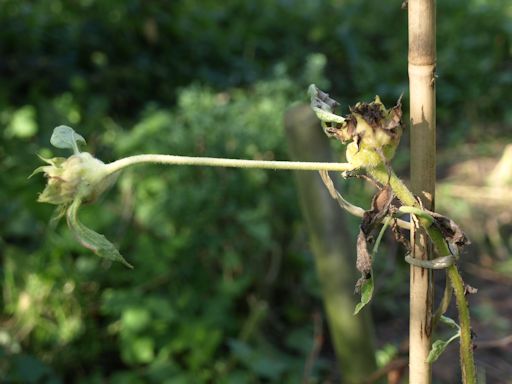
"Unfortunately, we were on holiday while it flowered," says Schwarze.
Readers who wish to repeat these experiments in their own backyard may order sunflowers, zinnias, and many other stratospheric seeds from Earth to Sky Calculus.
Realtime Spaceweather Photo Gallery