SLIGHT CHANCE OF METEORS: A new meteor shower could appear this week. According to theoretical modeling by Mikhail Maslov, Earth will pass through a sparse cloud of meteoroids from Comet 252P/LINEAR on March 28-30. The encounter could cause a minor shower of slow meteors emerging from a radiant near the star μ Leporis, south of the celestial equator. Little is known about meteors from 252P/LINEAR, so estimates of the meteor rate are very uncertain. Maslov's models suggest no more than 5 to 10 per hour.
SOLAR CYCLE CRASHING: Anyone wondering why the sun has been so quiet lately? The reason may be found in the graph below. The 11-year sunspot cycle is crashing:
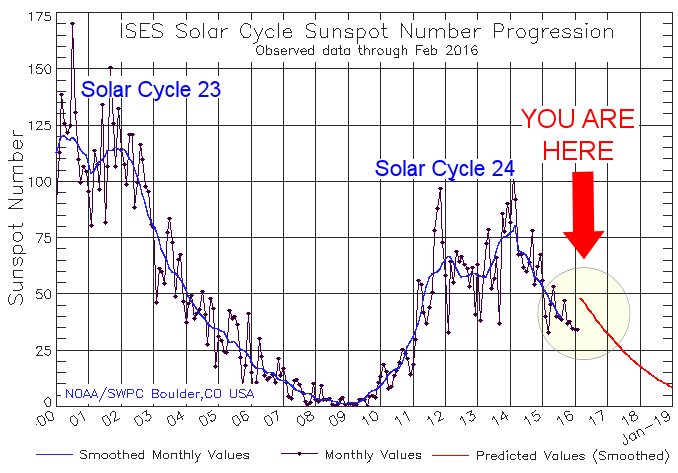
For the past two years, the sunspot number has been dropping as the sun transitions from Solar Max to Solar Min. Fewer sunspots means there are fewer solar flares and fewer coronal mass ejections (CMEs). As these explosions subside, we deem the sun "quiet."
But how quiet is it, really?
A widely-held misconception is that space weather stalls and becomes uninteresting during periods of low sunspot number. In fact, by turning the solar cycle sideways, we see that Solar Minimum brings many interesting changes. For instance, the upper atmosphere of Earth collapses, allowing space junk to accumulate around our planet. The heliosphere shrinks, bringing interstellar space closer to Earth. And galactic cosmic rays penetrate the inner solar system with relative ease. Indeed, a cosmic ray surge is already underway. (Goodbye sunspots, hello deep-space radiation.)
Stay tuned for updates as the sunspot number continues to drop.
Realtime Spaceweather Photo Gallery
SOLAR WIND SPARKS AURORAS: Earth is entering a stream of fast-moving solar wind, and this is causing geomagetic activity around the Arctic Circle. "At about 2:15 a.m. on March 28th, auroras erupted over Fairbanks, Alaska," reports John Chumack, who took this picture at the peak of the 2+ hour display:

"The icy fog we encountered earlier in the evening would have sent home many observers," he says. "We are so glad we stayed and waited. The greens and reds were incredible!"
More lights are in the offing tonight. NOAA forecasters estimate a 40% chance of G1-class geomagnetic storms on March 28-29 in response to buffeting by the solar wind. Spring twilight is beginning to decrease the visibility of auroras around the Arctic Circle, but as Chumack's photo shows, aurora season is not over yet. Aurora alerts: text or voice

PLANT YOUR OWN SPACE GARDEN: Northern spring has arrived, and that means it's time to plant flowers. Mutant space flowers, that is. These Zinnia seeds flew to the edge of space aboard an Earth to Sky Calculus helium balloon on Feb. 17, 2016:

En route, the seeds were exposed to comic ray doses more than 100x Earth normal, temperatures as low as -63C, and air pressures only 0.3% of sea level.
Zinnias are interesting because they have recently blossomed on the International Space Station. Maybe it's time to plant these space flowers in your garden, too. For $49.95 you can have some. Each order comes with one seed packet flown to the edge of space, and a second seed packet that was kept on Earth as a control sample. Plant them side by side to discover the effect of near-space flight on your flowers. All proceeds support student research.
Speaking of mutants, we have also flown sunflower seeds to the edge of space, where they soaked up cosmic rays for more than 2 hours. What happens when you plant such seeds? Spaceweather.com reader Christian Schwarze bought some and found out. "A second flower grew out of the side of the first one," he says. "Very strange!"

"Unfortunately, we were on holiday while it flowered," says Schwarze.
Readers who wish to repeat these experiments in their own backyard may order sunflowers, zinnias, and many other stratospheric seeds from Earth to Sky Calculus.