CHANCE OF STORMS: NOAA forecasters estimate a 45% chance of polar geomagnetic storms late on April 1st when a CIR is expected to hit Earth's magnetic field. CIRs (co-rotating interaction regions) are transition zones between fast- and slow-moving solar wind streams. Density gradients and shock waves inside CIRs often do a good job sparking auroras. Aurora alerts: text or voice
THE GIANT GREEN ATMOSPHERE OF A COMET: Earlier this month, on March 21st, Comet 252P/LINEAR buzzed Earth only 5.4 million km away. It was the 3rd-closest approach by any comet in recorded history. Since then, amateur astronomer Michael Jäger has been tracking the comet, taking ever-improving pictures as 252P races into northern skies over his private observatory in Stixendorf, Austria. His latest image, obtained on March 31st, reveals the comet's magnificent green atmosphere:
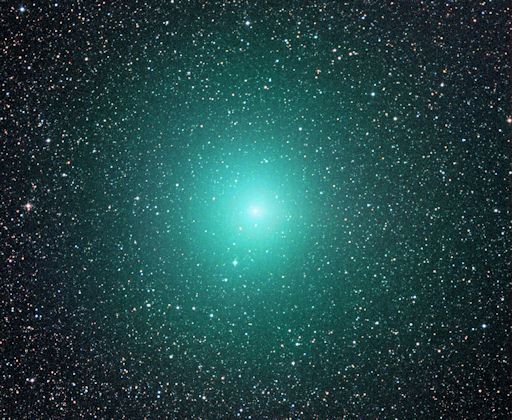
The green cloud in Jäger's photo comes from jets of gas spewing out of the comet's core. While the comet's icy core is tiny, perhaps only a few km wide, the surrounding atmosphere is enormous. The gas cloud measures 90,000 km across. This means it is more than half the size of the planet Jupiter, and about twice as wide as Neptune. Comet 252P/LINEAR is a gas giant, indeed.
The comet is green because its vaporizing nucleus emits diatomic carbon, C2, a gas which glows green in the near-vacuum of space. Astronomers who wish to see the verdant hue for themselves can point their telescopes using this ephemeris. Mid-sized telescopes and CCD cameras are required for best results.
Realtime Comet Photo Gallery
[Resources: brightness measurements, 3D orbit, orbital elements]
QUIET SUNSPOT: Sunspot AR2526 is big enough to swallow our entire planet--twice--and today it is crossing the center of the solar disk, directly facing Earth. Amateur astronomer J. P. Brahic took advantage of the crossing to photograph the behemoth from his backyard observatory in Uzès, France:

Surrounded by a maelstrom of swirling red-hot plasma, the sunspot's dark core looks menacing indeed. But looks can be deceiving. In fact, sunspot AR2526 is one of the least threatening sunspots to come along this year. AR2526 has a stable magnetic field that resists exploding. As a result, NOAA forecasters say there is no more than a 1% chance of a strong solar flare for the next three days.
Observers are nevertheless encouraged to turn their solar telescopes toward the sun. What AR2526 lacks in explosiveness, it makes up for in beauty. A photo-op awaits.
Realtime Spaceweather Photo Gallery
SCIENCE FAIR AT THE EDGE OF SPACE: Around the USA, science fairs are underway in all 50 states. Middle-school student Sydney R. of Turlock, California, decided to do her experiment at the edge of space. On March 23rd, she flew packets of baker's yeast to the stratosphere onboard an Earth to Sky Calculus helium balloon. The fungi reached an altitude of 116,181 feet:

At the apex of the flight, the yeast absorbed doses of cosmic radiation more than 100x Earth-normal. Meanwhile, back on Earth, control samples remained in their usual place in the kitchen cupboard. The two samples, flown vs. control, form the basis of Sydney's experiment.
She plans to do some "space baking." Sydney has a recipe for brownies that calls for yeast, and she is going to prepare the dessert using both kinds of leavening. Does space yeast make the same delicious brownies as terrestrial yeast? Hungry astronauts would love to know.
HEY, THANKS: Spaceweather.com and the students of Earth to Sky Calculus fly balloons to the stratosphere approximately once a week to monitor increasing levels of cosmic rays. Sydney's dad, David, sponsored one of those flights so that Sydney's science fair project could ride along. We thank them for their support!