GEOMAGNETIC STORM IN PROGRESS: A G1-class geomagnetic storm is in progress on April 2nd as Earth enters a stream of fast-moving solar wind. This is the storm we predicted on Friday. It was kicked off by the arrival of a CIR (co-rotating interaction region) and is now intensifying as solar wind buffets Earth's magnetic field.

The sun was about to rise over New Zealand when the storm began, but it was still dark enough to see the Southern Lights:

"A beautifully subtle aurora greeted me when I woke up this morning," says photographer Ian Griffin of Hoopers Inlet, Otago. "So I set off to my favourite viewing spot and captured a couple of pictures of the start of what could be a super solar storm over the next few days."
The incoming solar wind stream is filled with "negative polarity" magnetic fields. Such fields can easily link to Earth's magnetic field, opening a crack in our planet's defenses against solar wind. This is why NOAA forecasters offer good odds of continued magnetic storming this weekend--a 60% chance on April 2nd followed by a 55% chance on April 3rd. Aurora alerts: text or voice
ALMOST-BLANK SUN: As the sunspot number continues to plummet, the face of the sun is increasingly blank. Today, only one sunspot punctuates the solar disk, circled in this April 2nd image from NASA's Solar Dynamics Observatory:

The name of the sunspot is "AR2526." It has a stable magnetic field that poses little threat for strong flares. Indeed, this lonely sunspot is so quiet that the sun's X-ray output is flat-lining.
In a matter of days, the sun could be completely blank. AR2526 is moving toward rhe sun's western limb where it will vanish early next week. If no new sunspot emerges to take its place, the solar disk will be 100% spotless--a sure sign that Solar Minimum is coming.
A widely-held misconception is that space weather stalls and becomes uninteresting during periods of low sunspot number. In fact, by turning the solar cycle sideways, we see that Solar Minimum brings many interesting changes. For instance, the upper atmosphere of Earth collapses, allowing space junk to accumulate around our planet. The heliosphere shrinks, bringing interstellar space closer to Earth. And galactic cosmic rays penetrate the inner solar system with relative ease. Indeed, a cosmic ray surge is already underway. Stay tuned for updates as the sunspot number continues to drop.
Realtime Spaceweather Photo Gallery
SPACE STATION VS. JUPITER: On March 31st, the International Space Station flew past Jupiter in the skies over Magurele, Romania. Maximilian Teodorescu photographed the near miss:
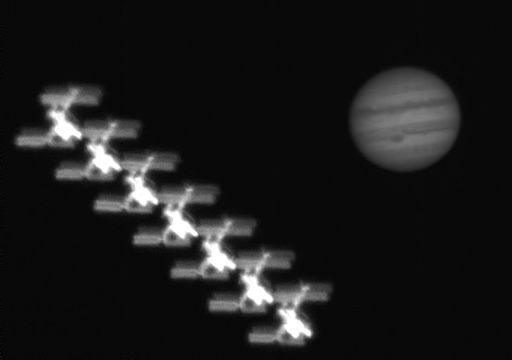
"The transit was predicted by Calsky," says Teodorescu. "Together with my wife and her brother, we traveled 40 kilometers from home to be in exactly the right spot to see the space station fly in front of Jupiter. It turns out, we were about 100 meters off, and the ISS missed the giant planet."
"Even so," he says, "the view was spectacular."
Teodorescu's image illustrates the scale of the space station. Measuring more than 100 meters wide, the behemoth spacecraft orbiting Earth is an easy target for backyard telescopes on the ground below. If it had passed directly in front of Jupiter, it would have blotted out much of the planetary disk.
The image also shows that the ISS has a higher surface brightness than Jupiter. That's because sunlight reflects easily from the station's metallic surfaces--much more so than from Jupiter's absorbing cloudtops. Indeed, sunlight glinting from the station's solar arrays sometimes causes flares as bright as magnitude -8, more than 200 times brighter than the entirety of the giant planet.
More information about Teodorescu's remarkable photo may be found here.
Realtime Spaceweather Photo Gallery
THE GIANT GREEN ATMOSPHERE OF A COMET: On March 21st, Comet 252P/LINEAR buzzed Earth only 5.4 million km away. It was the 3rd-closest approach by any comet in recorded history. Since then, amateur astronomer Michael Jäger has been tracking the comet, taking ever-improving pictures as 252P races into northern skies over his private observatory in Stixendorf, Austria. His latest image, obtained on March 31st, reveals the comet's magnificent green atmosphere:
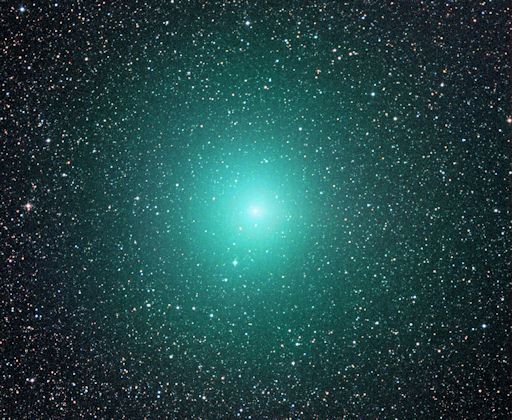
The green cloud in Jäger's photo comes from jets of gas spewing out of the comet's core. While the comet's icy core is tiny, perhaps only a few km wide, the surrounding atmosphere is enormous. The gas cloud measures 90,000 km across. This means it is more than half the size of the planet Jupiter, and about twice as wide as Neptune. Comet 252P/LINEAR is a gas giant, indeed.
The comet is green because its vaporizing nucleus emits diatomic carbon, C2, a gas which glows green in the near-vacuum of space. Astronomers who wish to see the verdant hue for themselves can point their telescopes using this ephemeris. Mid-sized telescopes and CCD cameras are required for best results.
Realtime Comet Photo Gallery
[Resources: brightness measurements, 3D orbit, orbital elements]