ANOTHER STREAM OF SOLAR WIND IS COMING: Geomagnetic activity is subsiding as Earth exits a solar wind stream that hit our planet's magnetic field on April 2nd. The quiet might not last long, however, because another stream of solar wind is coming. Estimated time of arrival: April 5th. NOAA forecasters say there is a a 55% chance of G1-class geomagnetic storms on Tuesday. Once again, Arctic sky watchers are favored for auroras. Aurora alerts: text or voice

WEEKEND AURORAS: A solar wind stream hit Earth's magnetic field on April 2nd, sparking a G2-class geomagnetic storm and bright auroras around the Arctic Circle. Göran Strand photographed the outburst of lights over Östersund, Sweden:


"This is an all-sky photo showing the entire sky at 23:19 UT on April 2nd," says Strand. "Northern Lights were everywhere!"
In high latitude places like Sweden, spring twilight is beginning to intrude on the midnight sky, making auroras increasingly difficult to see. "Aurora season is quickly running out," laments Strand. " I hope to see some more before the bright nights return."
He may get his wish. Another stream of solar wind is on the way, due to reach Earth on April 5th. Moreover, the incoming stream is filled with "negative polarity" magnetic fields. Such fields can easily link to Earth's magnetic field, opening a crack in our planet's defenses against solar wind. This sets the stage for a new round of Arctic lights early this week. Aurora alerts: text or voice
SPHERICAL ASTRONOMY CAMERA: Astrophotographers are increasingly impressed by a new camera on the market. It's the Ricoh Theta S, and it can take spherical images and videos under a wide range of astronomical conditions. The students of Earth to Sky Calculus have used it to photograph the edge of space from a freezing helium balloon flying 117,000 feet above Earth, as well as a total eclipse of the sun from a balmy beach only a few feet above sea level in Indonesia. Last week in Europe, photographers Karoline Mrazek and Erwin Matys found a new use for the Ricoh Theta S. "It makes a great survey instrument for light pollution," they say. Click on the image for a 360-degree view:

"We did an exposure at Star Meadow, the endpoint of the Grossmugl Star Walk in Austria," they explain. "It shows that the environment is 'clouded' by light pollution as much as 20 degrees above the horizon. This will help us plan future observing sessions at this otherwise dark-sky site."
Mrazek and Matys are founding members of the astrophotography group project nightflight. They've been testing the Ricoh Theta S in many settings for night-sky photography. Their complete report on spherical astrophotography is highly recomended. Read it here.
Realtime Spaceweather Photo Gallery
THE GIANT GREEN ATMOSPHERE OF A COMET: On March 21st, Comet 252P/LINEAR buzzed Earth only 5.4 million km away. It was the 3rd-closest approach by any comet in recorded history. Since then, amateur astronomer Michael Jäger has been tracking the comet, taking ever-improving pictures as 252P races into northern skies over his private observatory in Stixendorf, Austria. His latest image, obtained on March 31st, reveals the comet's magnificent green atmosphere:
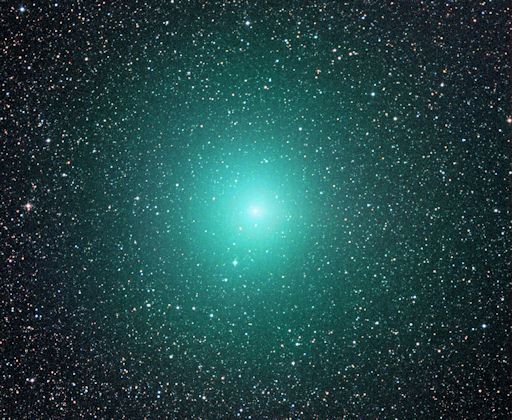
The green cloud in Jäger's photo comes from jets of gas spewing out of the comet's core. While the comet's icy core is tiny, perhaps only a few km wide, the surrounding atmosphere is enormous. The gas cloud measures 90,000 km across. This means it is more than half the size of the planet Jupiter, and about twice as wide as Neptune. Comet 252P/LINEAR is a gas giant, indeed.
The comet is green because its vaporizing nucleus emits diatomic carbon, C2, a gas which glows green in the near-vacuum of space. Astronomers who wish to see the verdant hue for themselves can point their telescopes using this ephemeris. Mid-sized telescopes and CCD cameras are required for best results.
Realtime Comet Photo Gallery
[Resources: brightness measurements, 3D orbit, orbital elements]