CHANCE OF MINOR STORMS TODAY: NOAA forecasters say there is a a 45% chance of G1-class geomagnetic storms today, April 5th, as Earth enters a moderately-fast stream of solar wind. Arctic sky watchers should be alert for auroras in the waxing Spring twilight. Aurora alerts: text or voice

ANTARCTIC LIGHTS: When the sun goes down over Halley Research Station in Antarctica, the darkening sky usually turns an icy shade of sunset red. On April 2nd, the primary color was, instead, green:
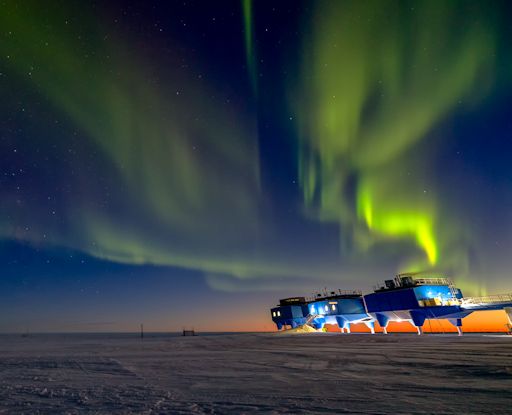
"The auroras were incredibly fast moving and at times covered with entire sky," says photographer Greig Lawson, the station's doctor, who ventured out onto the ice during a G2-class geomagnetic storm. "They were clearly visible even while the sun was still setting."

Operated by the British Antarctic Survey, the Halley Research Station is known for its studies of ozone, cosmic rays, and climate change. It is located on the Brunt Ice Shelf, a 130 meter thick slab of frozen water that floats atop the Weddell Sea. Such a platform is a dangerous place to be. Pieces of the shelf frequently break off, or "calve," giving birth to new icebergs. The current base structure, Halley VI, can avoid unstable ice by relocating itself. The station's colorful modules are built upon huge hydraulic skis.

Lawson will be busy in the months ahead tending to the station's wintertime staff of 16. Hopefully, he'll have time send more pictures. As the Arctic brightens, making Northern Lights difficult to see, the Antarctic will darken, providing a velvety canvas for geomagnetic storms to paint their colors on southern skies.
BIG RED RAINBOW: Sometimes clouds and rain vex astronomers. On April 4th, they had the opposite effect. "I am the director of the David M. Brown Planetarium," says Jonathan Harmon of Arlington, Virginia. "As I was preparing to open the doors for a Monday evening star show inside, I had to delay due to the amazing show outside." The show was a big red rainbow:

"I had to stitch 4 images together to catch the full arch over the planetarium dome," says Harmon.
Harmon's rainbow towered so high in the sky because the sun was hanging so low. Rainbows are always centered on the point directly opposite the sun. As the sun sets, the rainbow rises. Sunset is also the reason for the rainbow's red hue. Sunlight illuminating raindrops behind the observatory were reddened by scattering from low-hanging air molecules and dust particles. Red sunlight makes red rainbows; it's as simple as that.
Realtime Space Weather Photo Gallery
SPHERICAL ASTRONOMY CAMERA: Astrophotographers are increasingly impressed by a new camera on the market. It's the Ricoh Theta S, and it can take spherical images and videos under a wide range of astronomical conditions. The students of Earth to Sky Calculus have used it to photograph the edge of space from a freezing helium balloon flying 117,000 feet above Earth, as well as a total eclipse of the sun from a balmy beach only a few feet above sea level in Indonesia. Last week in Europe, photographers Karoline Mrazek and Erwin Matys found a new use for the Ricoh Theta S. "It makes a great survey instrument for light pollution," they say. Click on the image for a 360-degree view:

"We did an exposure at Star Meadow, the endpoint of the Grossmugl Star Walk in Austria," they explain. "It shows that the environment is 'clouded' by light pollution as much as 20 degrees above the horizon. This will help us plan future observing sessions at this otherwise dark-sky site."
Mrazek and Matys are founding members of the astrophotography group project nightflight. They've been testing the Ricoh Theta S in many settings for night-sky photography. Their complete report on spherical astrophotography is highly recomended. Read it here.
Realtime Spaceweather Photo Gallery