SLIGHT CHANCE OF STORMS: Earth's magnetic field is under the weak influence of a solar wind stream blowing high above our planet's north pole. As a result there is a slight chance (35%) of minor geomagnetic storms and Arctic auroras on April 6th. Aurora alerts: text or voice
MOON-VENUS CONJUNCTION: This morning in the brightening skies of Europe, a small number of astronomers witnessed a challenging conjunction of Venus and the crescent Moon. Mohamad Soltanolkotabi sends this picture from Tenerife, Spain:

"I was pretty lucky to catch this conjunction so deep in morning twilight, among patchy clouds," says Soltanolkotabi. "The Moon appeared in the eastern horizon in Tenerife island while Venus was only 0.1° far away from the crescent. It was a fantastic memorable experience!"
Later, as the sun rose and the sky turned blue, the crescent Moon actually passed in front of Venus. Dr. Fritz Helmut Hemmerich, also in Tenerife, captured the first moments of the occultation. "I was driving to work," he says, "when we saw the occultation getting underway. Fortunately I had a camera with me." Take a look at his lucky shot.
This may be the last we see of Venus for a while. The second planet is disappearing into the glare of sunrise as it begins a 2+ month trip around the farside of the sun. It will reappear in late June as a bright and beautiful Evening Star. Until then, browse the Venus photo gallery.
ANTARCTIC LIGHTS: When the sun goes down over Halley Research Station in Antarctica, the darkening sky usually turns an icy shade of sunset red. On April 2nd, the primary color was, instead, green:
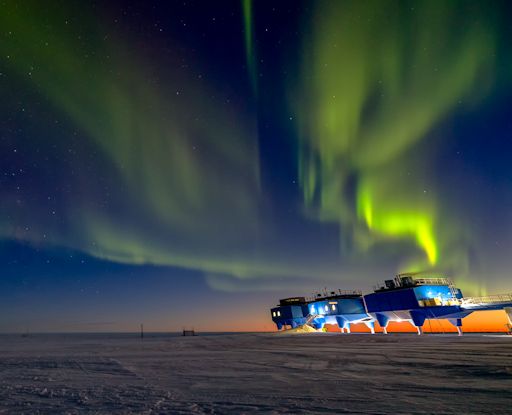
"The auroras were incredibly fast moving and at times covered with entire sky," says photographer Greig Lawson, the station's doctor, who ventured out onto the ice during a G2-class geomagnetic storm. "They were clearly visible even while the sun was still setting."

Operated by the British Antarctic Survey, the Halley Research Station is known for its studies of ozone, cosmic rays, and climate change. It is located on the Brunt Ice Shelf, a 130 meter thick slab of frozen water that floats atop the Weddell Sea. Such a platform is a dangerous place to be. Pieces of the shelf frequently break off, or "calve," giving birth to new icebergs. The current base structure, Halley VI, can avoid unstable ice by relocating itself. The station's colorful modules are built upon huge hydraulic skis.

Lawson will be busy in the months ahead tending to the station's wintertime staff of 16. Hopefully, he'll have time send more pictures. As the Arctic brightens, making Northern Lights difficult to see, the Antarctic will darken, providing a velvety canvas for geomagnetic storms to paint their colors on southern skies.
BIG RED RAINBOW: Sometimes clouds and rain vex astronomers. On April 4th, they had the opposite effect. "I am the director of the David M. Brown Planetarium," says Jonathan Harmon of Arlington, Virginia. "As I was preparing to open the doors for a Monday evening star show inside, I had to delay due to the amazing show outside." The show was a big red rainbow:

"I had to stitch 4 images together to catch the full arch over the planetarium dome," says Harmon.
Harmon's rainbow towered so high in the sky because the sun was hanging so low. Rainbows are always centered on the point directly opposite the sun. As the sun sets, the rainbow rises. Sunset is also the reason for the rainbow's red hue. Sunlight illuminating raindrops behind the observatory were reddened by scattering from low-hanging air molecules and dust particles. Red sunlight makes red rainbows; it's as simple as that.
Realtime Space Weather Photo Gallery