SPACE WEATHER ON FACEBOOK: Are you on Facebook? Good news: So is Spaceweather.com! If you would like to see our daily content in your Facebook feed, just click here and follow us.
SUNSET SKY SHOW: When the sun goes down tonight, step outside and look west. Mercury and the slender crescent Moon are shining side-by-side in the rosy glow of sunset. If you can't see them with the unaided eye, try binoculars. It's a great way to end the day. [sky map]

GEOMAGNETIC STORM: On April 7th, Earth crossed a fold in the heliospheric current sheet, plunging our planet into a region of space filled with "negative-polarity" magnetic fields. This sparked a G1-class geomagnetic storm and bright auroras around the Arctic Circle. "Suddenly, the sky exploded in color," reports Janne Maj Nagelsen, who took this picture from Stamnes, Vaksdal, Norway:

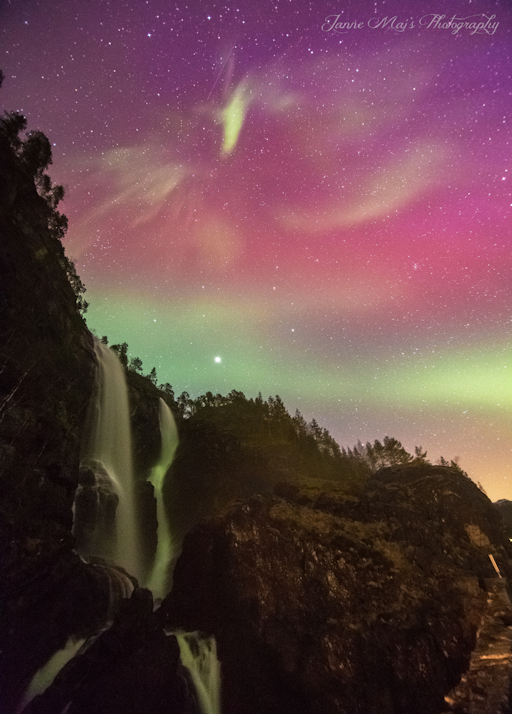
"I've waited for so many years to take this picture, because the Northern Lights has never been high enough in the sky before," says Nagelsen. "It was amazing."
Many people have never heard of the heliospheric current sheet. It is one of the biggest things in the solar system--a vast undulating system of electrical currents shaped like the skirt of a ballerina: picture. Earth dips in and out of it all the time.
NOAA forecasters estimate a 55% chance of continued storming on April 8th as Earth slowly exits this region of space. High-latitude sky watchers should remain alert for auroras. Aurora alerts: text or voice
PLANET-SIZED SUNSPOT: As expected, a large sunspot has emerged over the sun's northwestern limb. AR2529 has a dark core as wide as Earth itself, as shown in this April 8th photo taken by Philippe Tosi of Nîmes, France:
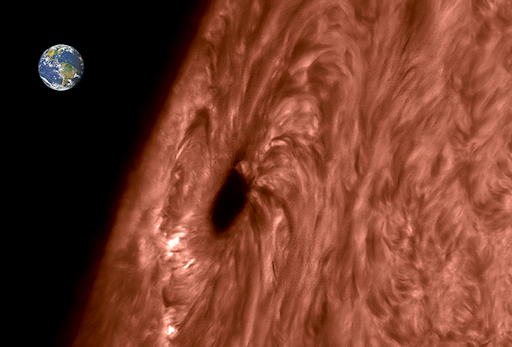
Sunspots are, essentially, islands of magnetism floating in a sea of solar plasma. This island is as wide as a planet. Magnetic fields arching above a sunspot can become tangled. They criss-cross and reconnect, exploding with the force of millions of atomic bombs. However, such a "solar flare" is unlikely in this case because the magnetic field of sunspot AR2529 is not tangled; it is stable and poses little threat for strong explosions. Solar activity is expected to remain low this weekend.
Realtime Space Weather Photo Gallery
ANTARCTIC LIGHTS: When the sun goes down over Halley Research Station in Antarctica, the darkening sky usually turns an icy shade of sunset red. On April 2nd, the primary color was, instead, green:
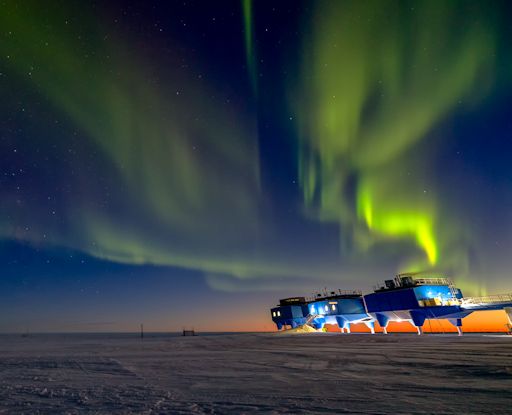
"The auroras were incredibly fast moving and at times covered with entire sky," says photographer Greig Lawson, the station's doctor, who ventured out onto the ice during a G2-class geomagnetic storm. "They were clearly visible even while the sun was still setting."

Operated by the British Antarctic Survey, the Halley Research Station is known for its studies of ozone, cosmic rays, and climate change. It is located on the Brunt Ice Shelf, a 130 meter thick slab of frozen water that floats atop the Weddell Sea. Such a platform is a dangerous place to be. Pieces of the shelf frequently break off, or "calve," giving birth to new icebergs. The current base structure, Halley VI, can avoid unstable ice by relocating itself. The station's colorful modules are built upon huge hydraulic skis.

Lawson will be busy in the months ahead tending to the station's wintertime staff of 16. Hopefully, he'll have time send more pictures. As the Arctic brightens, making Northern Lights difficult to see, the Antarctic will darken, providing a velvety canvas for geomagnetic storms to paint their colors on southern skies.
Realtime Space Weather Photo Gallery
Realtime Comet Photo Gallery
[More about Comet 252P: brightness measurements, 3D orbit, orbital elements]