SPACE WEATHER ON FACEBOOK: Are you on Facebook? Good news: So is Spaceweather.com! If you would like to see our daily content in your Facebook feed, just click here and follow us.
BIG SUNSPOT GETS BIGGER: Sunspot AR2529 has more than doubled in size this weekend, making it by far the largest sunspot of 2016 to date. Around the world amateur astronomers are photographing the behemoth. Jean-Pierre Brahic of Uzès, France, took this picture on April 9th of the swirling maelstrom of magnetic fields at the sunspot's dark core:

As the inset image of Earth shows, the sunspot's core is wide enough to swallow our planet--twice. Fortunately we are 93 million miles away.
NASA's Solar Dynamics Observatory (SDO) is keeping a close eye on this active region. Magnetic fields near the sunspot's core are crackling with minor C-class solar flares. None of these flares are very strong, but the ensemble of explosions is doing a good job heating the sun's atmosphere above the sunspot. The towering "hot spot" is shown in this extreme ultraviolet image taken by SDO on April 10th:

Despite its large size and state of unrest, AR2529 has not yet launched a significant solar storm. C-class flares are considered to be small. Stronger flares may be in the offing, however, if the sunspot continues to grow in the days ahead. Stay tuned. Solar flare alerts: text or voice
Realtime Space Weather Photo Gallery
DRAGON SPACECRAFT CHASES, CATCHES THE ISS: Launched just two days ago, SpaceX's Dragon CRS-8 spacecraft has spent the weekend chasing the International Space Station around Earth. Last night, April 9th, in Normandy, France, photographer Guillaume Doyen witnessed the pursuit:

"The ISS had just passed overhead when I saw the small and sharp point following it," he says. "Hello Dragon, what a surprise!"
The Dragon CRS-8 is carrying almost 7,000 pounds of cargo to the space station--including a new inflatable addition to the station's sprawling structure. The Bigelow Expandable Activity Module--BEAM for short--will arrive in Dragon's unpressurized trunk and, after about five days, will be removed and attached to the station. Expansion is targeted for the end of May. The module will expand to roughly 10 feet in diameter and 13 feet long.
Expandable habitats are designed to take up less room on a rocket, but provide greater volume for living and working in space once expanded. This first in situ test of the module will allow investigators to gauge how well the habitat protects against solar radiation, space debris and contamination.
Not long after Doyen saw them in the skies over France, the Dragon and the ISS docked on Sunday, April 10th. Visit NASA.gov for more information.
EXOTIC GREEN FLASH: Seaside photographers have a special fondness for the sunset. On rare occasions they can catch the elusive green flash--a split-second pulse of verdant light that signals the disappearance of the sun beneath the ocean waves. On April 7th, astronomy professor Jimmy Westlake photographed a green flash as he stood atop Hawaii's Mauna Kea volcano. The flash he saw, however, did not come from the ocean waves. It happened in the clouds:
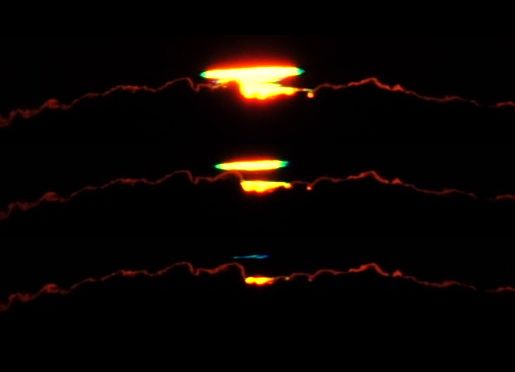
"The SKY Club from Colorado Mountain College got an emerald surprise," he says. "Several students visually witnessed the green flash while I was photographing it."
"This appears to be a cloud-top flash," says atmospheric optics expert Les Cowley. "They are not fully understood but might be produced by an inversion layer overlaying the clouds."
Basically, a temperature inversion bends the sun's rays to form a mirage that vertically magnifies the tiny color separation which is always present at the edge of the setting sun. In Westlake's flash, we see not only green, but also yellow, red, and even a wisp of blue. "The intensity of the blue-green flash caught everyone by surprise!" says Westlake.
Realtime Comet Photo Gallery
[More about Comet 252P: brightness measurements, 3D orbit, orbital elements]