GEOMAGNETIC STORM IN PROGRESS: A G1-class geomagnetic storm is in progress on April 12th as Earth enters a stream of fast-moving solar wind. High-latitude sky watchers should be alert for auroras in the hours ahead. [photo gallery]

The incoming solar wind stream is pouring out of a hole in the sun's atmosphere--a "coronal hole"--shown in this image from NASA's Solar Dynamics Observatory:

Coronal holes are places in the sun's upper atmosphere where the magnetic field peels back and allows solar wind to escape. In the image, above, the sun's magnetic field is traced by pale arcing lines. Arrows indicate the flow of solar wind.
All solar wind streams carry some of the sun's magnetic field into space. The stream now heading for Earth appears to be filled with "negative polarity" magnetic fields. Such fields can easily link to Earth's magnetic field, opening a crack in our planet's defenses against solar wind. As a result, this solar wind stream could be effective at sparking auroras. Aurora alerts: text or voice
SPACE ROSES: Last week, the students of Earth to Sky Calculus launched a daring experiment. Daring for the flowers, that is. A bouquet of live roses flew to the edge of space onboard a helium balloon to find out if if they could survive the trip. The answer, apparently, is "yes." Here are the blossoms floating 35.4 km (116,000 feet) above Earth's surface:
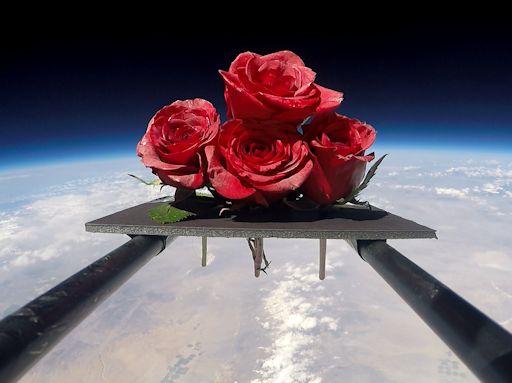 .
The roses were hitchikers on a cosmic ray payload, which went to the stratosphere to monitor increasing levels of space radiation. En route to the top, the flowers were exposed to a dose of cosmic rays 100x Earth normal, air pressures as low as 0.2% of sea level, and temperatures as low as -63 C. Three hours later, the roses parachuted back to Earth and landed ... in Death Valley! Talk about a rough trip.
And now we come to Mother's Day. These flowers, which were pressed after recovery, are available as gifts. Buy one here and give mom something truly out of this world on May 8th. Each pressed rose comes with a unique card showing the flowers in flight. All proceeds support the student space weather research of Earth to Sky Calculus.
BIG SUNSPOT: The sun's headlong plunge into solar minimum has been interrupted by the surprise emergence of a big sunspot. AR2529 doubled in size over the weekend, and the behemoth spot is now being photographed by amateur astronomers around the world. "I just managed to capture this magnificent sunspot late yesterday afternoon in between the dark thundering clouds with the video feature on my Canon 700D camera," reports Noeleen Lowndes of Leyburn QLD Australia:
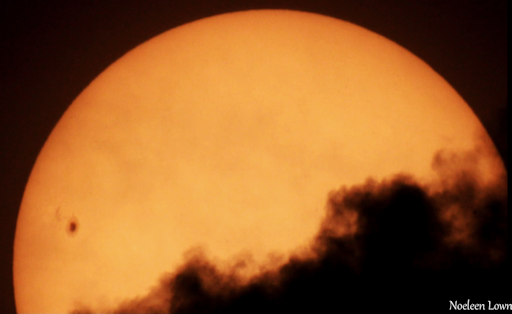
"It's been a long time since we've had such a beauty on the Sun's surface," says Lowndes, "and I can't wait to see how it's going to progress in the next few days."
A coronal mass ejection (CME) from this sunspot may be approaching Earth. The plasma cloud left the region on April 10th during an hours-long period of unrest in the sunspot's core, documented in this movie from NASA Solar Dynamics Observatory:
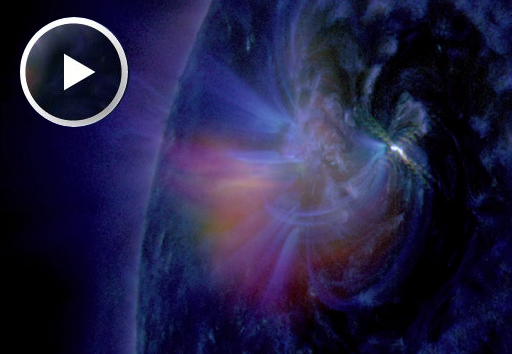
During the sequence, a magnetic flux tube disconnected and reconnected, expelling plasma out into space. The CME, along with another that occurred a few hours later, could deliver a glancing blow to Earth's magnetic field on April 13th. Any CME strike would add to the effects of a negative-polarity solar wind stream already buffeting Earth's magnetic field. Solar flare alerts: text or voice
Realtime Space Weather Photo Gallery
EXOTIC GREEN FLASH: Seaside photographers have a special fondness for the sunset. On rare occasions they can catch the elusive green flash--a split-second pulse of verdant light that signals the disappearance of the sun beneath the ocean waves. On April 7th, astronomy professor Jimmy Westlake photographed a green flash as he stood atop Hawaii's Mauna Kea volcano. The flash he saw, however, did not come from the ocean waves. It happened in the clouds:
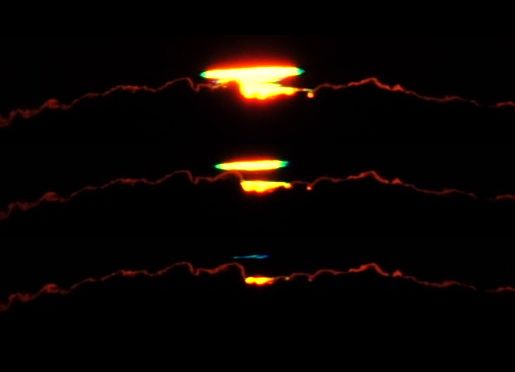
"The SKY Club from Colorado Mountain College got an emerald surprise," he says. "Several students visually witnessed the green flash while I was photographing it."
"This appears to be a cloud-top flash," says atmospheric optics expert Les Cowley. "They are not fully understood but might be produced by an inversion layer overlaying the clouds."
Basically, a temperature inversion bends the sun's rays to form a mirage that vertically magnifies the tiny color separation which is always present at the edge of the setting sun. In Westlake's flash, we see not only green, but also yellow, red, and even a wisp of blue. "The intensity of the blue-green flash caught everyone by surprise!" says Westlake.
Realtime Comet Photo Gallery
[More about Comet 252P: brightness measurements, 3D orbit, orbital elements]