ARCTIC AURORAS: A high-speed stream of solar wind is buffeting Earth's magnetic field, and this is sparking intermittent geomagnetic storms around the Arctic Circle. Last night in the Finnish Lapland, "the sky exploded into many colors," reports B.Art Braafhart, who sends this picture from the Salla ski resort:


"Winter is not yet over here in Salla," says Braafhart. "The temperature dropped to a nice cracking -7 C as the auroras danced across the sky."
Later today, a minor CME from sunspot AR2529 could deliver a glancing blow to Earth's magnetic field. Such an impact would add to the effect of the solar wind stream, already here. NOAA forecasters estimate a 70% chance of more G1-class geomagnetic storms on April 13th. Aurora alerts: text or voice
SPACE ROSES: Last week, the students of Earth to Sky Calculus launched a daring experiment. Daring for the flowers, that is. A bouquet of live roses flew to the edge of space onboard a helium balloon to find out if if they could survive the trip. The answer, apparently, is "yes." Here are the blossoms floating 35.4 km (116,000 feet) above Earth's surface:
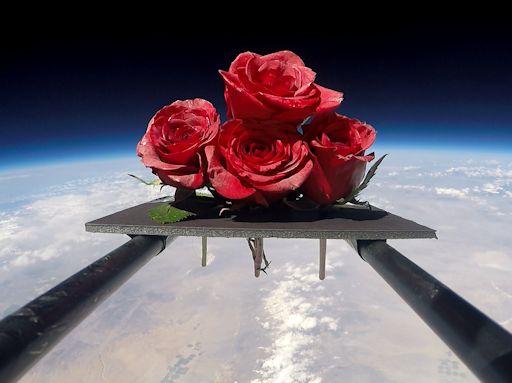 .
The roses were hitchikers on a cosmic ray payload, which went to the stratosphere to monitor increasing levels of space radiation. En route to the top, the flowers were exposed to a dose of cosmic rays 100x Earth normal, air pressures as low as 0.2% of sea level, and temperatures as low as -63 C. Three hours later, the roses parachuted back to Earth and landed ... in Death Valley! Talk about a rough trip.
And now we come to Mother's Day. These flowers, which were pressed after recovery, are available as gifts. Buy one here and give mom something truly out of this world on May 8th. Each pressed rose comes with a unique card showing the flowers in flight. All proceeds support the student space weather research of Earth to Sky Calculus.
I HEART SUNSPOT: Big sunspot AR2529 is now directly facing Earth, giving solar astronomers a clear view of the behemoth active region. This morning, April 13th, Karzaman Ahmad of the Langkawi National Observatory in Malaysia took a closer look and found that the sunspot is shaped like a heart:

Ahmad inserted a picture of Earth to show the scale of the sunspot. The primary dark core is several times wider than our entire planet. You have to love a sunspot with those kind of dimensions. It is an easy target for backyard solar telescopes.
Since it appeared less than a week ago, AR2529 has been mostly, but not completely, quiet. On April 10th it hurled a minor CME into space. That CME, along with another that occurred a few hours later, could deliver a glancing blow to Earth's magnetic field on April 13th. Solar flare alerts: text or voice
Realtime Space Weather Photo Gallery
Realtime Comet Photo Gallery
[More about Comet 252P: brightness measurements, 3D orbit, orbital elements]