SIDESWIPED WITH BEAUTY: As expected, a CME sideswiped Earth's magnetic field this morning April 14th, at approximately 0700 UT. The glancing blow produced a G1-class geomagnetic storm and auroras around the both poles. Taichi Nakamura photographed the distant glow of south polar lights from a beach in Dunedin New Zealand:

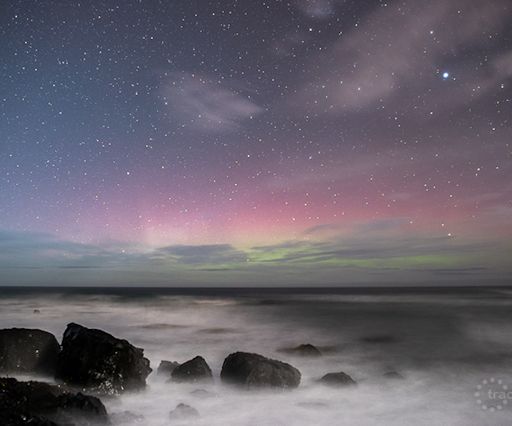
"The warmth at the beach disappeared as the night darkened and with it the aurora starting to rise," says Nakamura. "The aurora shined brightly in the moonlit sky in between moments of clearance in the clouds."
The storm has subsided now, but isolated substorms could trigger more outbursts of light in the hours ahead as Earth moves through the CME's magnetized wake. High-latitude sky watchers should remain alert for auroras on April 14-15. Aurora alerts: text or voice
I HEART SUNSPOT: You gotta love AR2529. The giant sunspot has morphed into a heart more than three times wider than Earth. Karzaman Ahmad of the Langkawi National Observatory in Malaysia photographed the active region on April 13th:
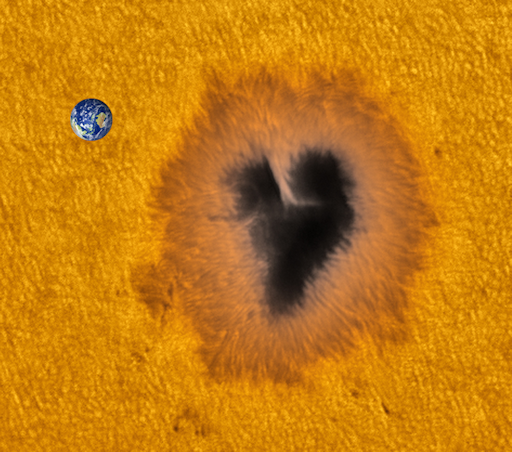
"I used an 11-inch Celestron telescope with solar filters to photograph the sunspot," says Ahmad. "It is very easy to see."
The dark heart of this sunspot is made of magnetism, a tangle of magnetic fields that blocks the upward flow of heat from the sun's interior. That's why it is dark, because it is cool compared to its fiery surroundings.
NOAA forecasters say there is a 10% chance of M-class solar flares from AR2529 on April 13th. If such a flare does occur, it will be geoeffective. The sunspot is directly facing Earth. Solar flare alerts: text or voice
Realtime Space Weather Photo Gallery
SPACE ROSES: Last week, the students of Earth to Sky Calculus launched a daring experiment. Daring for the flowers, that is. A bouquet of live roses flew to the edge of space onboard a helium balloon to find out if if they could survive the trip. The answer, apparently, is "yes." Here are the blossoms floating 35.4 km (116,000 feet) above Earth's surface:
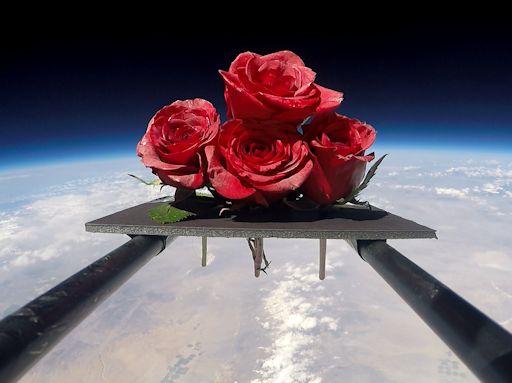 .
The roses were hitchikers on a cosmic ray payload, which went to the stratosphere to monitor increasing levels of space radiation. En route to the top, the flowers were exposed to a dose of cosmic rays 100x Earth normal, air pressures as low as 0.2% of sea level, and temperatures as low as -63 C. Three hours later, the roses parachuted back to Earth and landed ... in Death Valley! Talk about a rough trip.
And now we come to Mother's Day. These flowers, which were pressed after recovery, are available as gifts. Buy one here and give mom something truly out of this world on May 8th. Each pressed rose comes with a unique card showing the flowers in flight. All proceeds support the student space weather research of Earth to Sky Calculus.
Realtime Comet Photo Gallery
[More about Comet 252P: brightness measurements, 3D orbit, orbital elements]