SUBSIDING STORM: Earth's magnetic field is quieting as the effects of yesterday's glancing CME impact subside. NOAA has downgraded the odds of a geomagnetic storm to 45% today and only 25% tomorrow. The best way to see auroras on April 15th: Browse the gallery.
SOLAR RADIO STATIC: Giant sunspot AR2529 is making noise, and it sounds like static. On April 14th, amateur astronomer Thomas Ashcraft heard a gentle crescendo of noise emerge from the loudspeaker of his shortwave radio telescope in New Mexico. "It was a Type III radio burst from the sun," he says. Click to listen (the static surges about 20 seconds into the audio file):

Type III radio bursts are caused by solar flares. Electrons accelerated by magnetic explosions race through the sun's atmosphere, causing a ripple of plasma waves and radio static. Sunspot AR2529 has been crackling with C-class flares, almost non-stop, and these are apparently the source of the static.
"The burst was recorded in stereo using two separate short wave receivers, one tuned at 20.030 MHz and the other at 21.119 MHz. Best listened to with headphones," says Ashcraft. Solar flare alerts: text or voice
Realtime Space Weather Photo Gallery
MARS AND SATURN: This weekend, if you wake up before sunrise, step outside and look south. Mars and Saturn are having a get together in the constellation Scorpius: sky map. The two bright planets, one burnt-orange and the other golden-hued, are very bright and easy to see with the naked eye. A bit of extra exposure with a digital camera reveals the planets surrounded by the star-forming clouds of the Milky Way:


Bill Metallinos of Corfu, Greece, took the picture before daybreak on April 12th. "I used an Canon EOS 5D MK2 digital camera set at ISO 800 for this 20x120 second exposure," he says. "The Rho Ophiuchi cloud complex showed up nicely alongside the planets."
Both Mars and Saturn are approaching Earth for close encounters in late May-early June. Mars will be at opposition on May 22nd followed by Saturn on June 3rd. At that time, the two worlds will be at their best for all of 2016--even brighter than they are now.
Until then, a date of special interest is April 25th, when the waxing full Moon passes by the planets, forming a bright triangle with Moon-Mars-Saturn vertices. Looking for the planets? Let Luna be your guide: sky map.

Realtime Space Weather Photo Gallery
SPACE ROSES: Last week, the students of Earth to Sky Calculus launched a daring experiment. Daring for the flowers, that is. A bouquet of live roses flew to the edge of space onboard a helium balloon to find out if if they could survive the trip. The answer, apparently, is "yes." Here are the blossoms floating 35.4 km (116,000 feet) above Earth's surface:
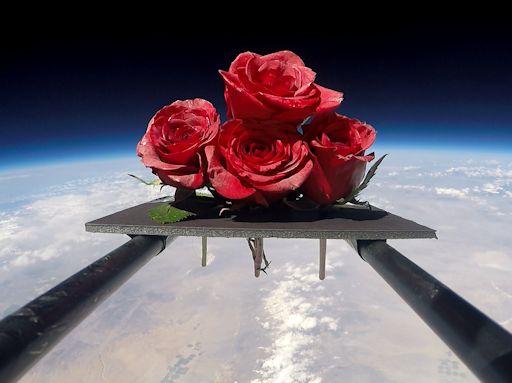 .
The roses were hitchikers on a cosmic ray payload, which went to the stratosphere to monitor increasing levels of space radiation. En route to the top, the flowers were exposed to a dose of cosmic rays 100x Earth normal, air pressures as low as 0.2% of sea level, and temperatures as low as -63 C. Three hours later, the roses parachuted back to Earth and landed ... in Death Valley! Talk about a rough trip.
And now we come to Mother's Day. These flowers, which were pressed after recovery, are available as gifts. Buy one here and give mom something truly out of this world on May 8th. Each pressed rose comes with a unique card showing the flowers in flight. All proceeds support the student space weather research of Earth to Sky Calculus.
Realtime Comet Photo Gallery
[More about Comet 252P: brightness measurements, 3D orbit, orbital elements]