SOLAR FLARE UPDATE: NOAA forecasters say that a CME hurled into space by today's M6.7-flare might deliver a glancing blow to Earth's magnetic field on April 20th. High-latitude sky watchers should be alert for auroras during a possible G1-class geomagnetic storm. Aurora alerts: text or voice

BIG SUNSPOT ERUPTS: Surprise! Quiet sunspot AR2529 isn't so quiet, after all. The heart-shaped active region erupted on April 18th (00:39 UT), producing a strong M6.7-class solar flare. NASA's Solar Dynamics Observatory recorded the flare's extreme ultraviolet flash:

A pulse of UV radiation from the flare ionized the top of Earth's atmosphere. This, in turn, disrupted shortwave radio communications over the daylit side of our planet. Mariners, aviators, and ham radio operators around the Pacific Ocean may have noticed fading signals at frequencies below ~15 MHz. A NOAA blackout map shows the frequencies and territories affected.

More M-class flares are possible in the days ahead. AR2529 has developed a 'beta-gamma' magnetic field that harbors plenty of energy for this kind of explosion. Although the sunspot is no longer directly facing Earth, it can still affect our planet by causing radio blackouts and glancing-blow CMEs. Stay tuned. Solar flare alerts: text or voice
Realtime Space Weather Photo Gallery
A SOLAR WIND STREAM IS COMING: Geomagnetic activity should remain low throughout the weekend. Conditions could shift to an active state late Monday, April 18th, when Earth enters a stream of high-speed solar wind. The solar wind is flowing out of this coronal hole on the sun:

Coronal holes are places in the sun's upper atmosphere where magnetic fields peel back, allowing solar wind to escape. In the image, above, from NASA's Solar Dynamics Observatory, the flow of solar wind is traced by arrows. The escaping material is now nearing Earth.
The incoming solar wind stream is filled with positive-polarity magnetic fields. This means it might not do a good job sparking auroras. Positive polarity magnetic fields from the sun do not easily link to Earth's planetary magnetic field. As a result, their effect on our magnetosphere is often muted. Stay tuned for updates.
SPACE ROSES: Last week, the students of Earth to Sky Calculus launched a daring experiment. Daring for the flowers, that is. A bouquet of live roses flew to the edge of space onboard a helium balloon to find out if if they could survive the trip. The answer, apparently, is "yes." Here are the blossoms floating 35.4 km (116,000 feet) above Earth's surface:
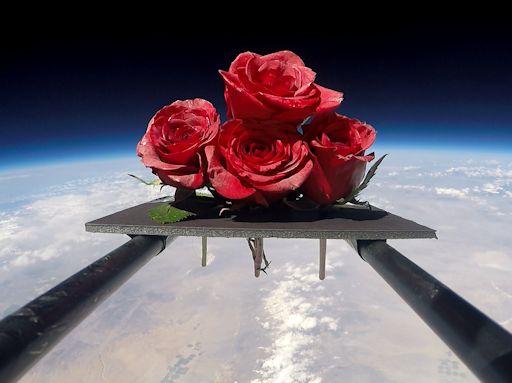 .
The roses were hitchikers on a cosmic ray payload, which went to the stratosphere to monitor increasing levels of space radiation. En route to the top, the flowers were exposed to a dose of cosmic rays 100x Earth normal, air pressures as low as 0.2% of sea level, and temperatures as low as -63 C. Three hours later, the roses parachuted back to Earth and landed ... in Death Valley! Talk about a rough trip.
And now we come to Mother's Day. These flowers, which were pressed after recovery, are available as gifts. Buy one here and give mom something truly out of this world on May 8th. Each pressed rose comes with a unique card showing the flowers in flight. All proceeds support the student space weather research of Earth to Sky Calculus.
Realtime Comet Photo Gallery
[More about Comet 252P: brightness measurements, 3D orbit, orbital elements]