LYRID METEOR SHOWER: Earth is approaching a stream of debris from Comet Thatcher, source of the annual Lyrid meteor shower. Normally, sky watchers would see 10 to 20 meteors per hour when the shower peaks on April 21-22. This year, however, visible meteor rates will be sharply reduced by the glare of the full Moon. If you can't see the Lyrids, try listening to them as meteor radar echoes on Space Weather Radio.
SUNSPOT MIRAGE: For many photographers, departing sunspot AR2529 was an irresistible target at sunset. The sunspot's heart-shaped core beamed through the rosy twilight, marking the sun for a unique shot. On April 16th in San Francisco, California, it got a little weird. "Both the sun and the sunspot were stretched and distorted as the sun sank behind the waves of the Pacific Ocean," says Mila Zinkova, who photographed the mirage:
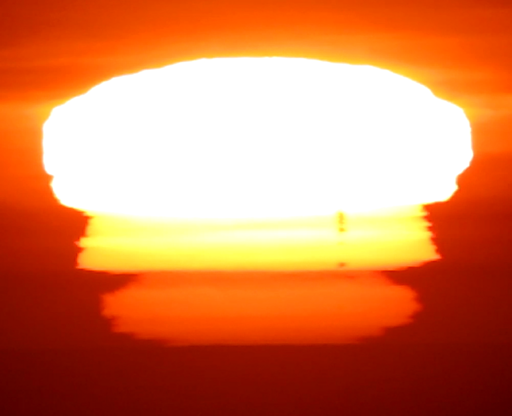
"Notice the vertical stretching of the sunspot," says she. "It was amazing to watch how the appearance of the sun changed as sunset progressed. Here is the full video."
Atmospheric optics expert Les Cowley explains what happened: "Each sunspot on Mila's picture is a mini mirage. The California Coast is famous for its temperature inversions. Air cooled by the offshore ocean current lies beneath warm air from inland. Sunset sunlight between the layers bends and splits into three mirage images. Two sun slices descend and one upside-down one rises. Nature is not always so simple though. In the case of Mila's sunset, there were multiple small inversion layers. Each inversion layer sliced up the sun like the corrugations of a Chinese lantern. If the air were steady enough we might see that some of the heart shaped sunspots were upside down."
Today, AR2529 has left the disk of the sun. Good-bye, and thanks for all the photo-ops.
Realtime Space Weather Photo Gallery
A DASH OF GREEN IN ARCTIC TWILIGHT: Around the Arctic Circle, night is vanishing as the summer sun rises over the polar realm. This is creating a short-lived mixture of colors in the sky: aurora green and twilight blue. Aleksander Chernucho sends this picture of the phenomenon from Russia's Kola peninsula:
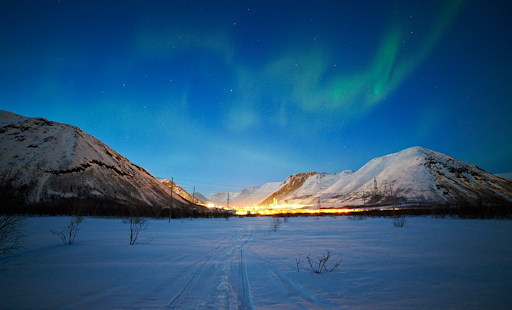 .
"I think summer vacation is about to begin," says Chernucho, "because these are the last auroras of the 2015-2016 season."
Or, maybe, the second-to-last. An incoming solar wind stream on April 24-25 could add one more dash of green to the twilight before the Arctic sun finally overwhelms the Northern Lights. Monitor the aurora gallery for last-chance sightings.