LYRID METEORS VS. THE FULL MOON: Earth is entering a stream of debris from Comet Thatcher, source of the annual Lyrid meteor shower. Normally, sky watchers would see 10 to 20 meteors per hour when the shower peaks during the night of April 21-22. This year, however, the Lyrids have competition. The full Moon is out tonight, too, and only the brightest Lyrids will pierce the glare.
Fortunately, there are some bright ones. Last night, NASA's network of all-sky meteor cameras caught this Lyrid fireball streaking over New Mexico, easily seen alongside the Moon:

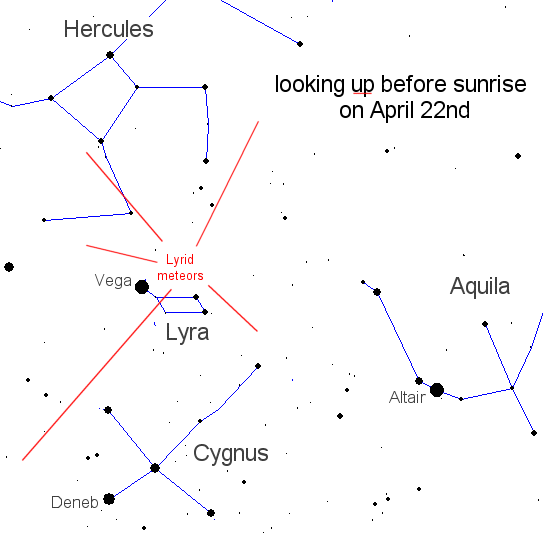
On April 20-21, NASA cameras picked up four Lyrid fireballs over the USA. That number could increase on April 21-22 as Earth moves deeper into the debris stream of Comet Thatcher. Can the Lyrids compete with the full Moon? We will find out tonight. [sky map]
There is one way to experience this shower unmitigated by moonlight. Try listening to Space Weather Radio for live radar echoes from Lyrid meteoroids. The Moon does not affect this method of detecting meteors. Good luck!
Realtime Space Weather Photo Gallery
SPROUTING GRASS MOON: There's a full moon tonight and according to folklore it has a special name--the "Sprouting Grass Moon," so-called because it shines down on the new grasses of northern spring. This morning, John Stetson watched the Moon set behind Sebago Lake, Maine, and he saw a grass-green fringe along the top of the lunar disk:

"Earth's atmosphere, acting as a lens, distorted the color and shape of the setting moon," says Stetson. "The green rim is caused by the prismatic action of the low atmosphere."
Other folk-names for this month's full Moon include the Pink Moon, the Egg Moon, and the Fish Moon. "Sprouting Grass" is our favorite! Monitor the photo gallery for more moonshots:
Realtime Space Weather Photo Gallery
A DASH OF GREEN IN ARCTIC TWILIGHT: Around the Arctic Circle, night is vanishing as the summer sun rises over the polar realm. This is creating a short-lived mixture of colors in the sky: aurora green and twilight blue. Aleksander Chernucho sends this picture of the phenomenon from Russia's Kola peninsula:
 .
"I think summer vacation is about to begin," says Chernucho, "because these are the last auroras of the 2015-2016 season."
Or, maybe, the second-to-last. An incoming solar wind stream on April 24-25 could add one more dash of green to the twilight before the Arctic sun finally overwhelms the Northern Lights. Monitor the aurora gallery for last-chance sightings.