SOLAR SECTOR BOUNDARY CROSSING (UPDATED): On April 29th or 30th, Earth will cross a fold in the heliospheric current sheet--a vast wavy structure in interplanetary space separating regions of opposite magnetic polarity. This is called a "solar sector boundary crossing," and it could trigger geomagnetic activity around Earth's poles. NOAA forecasters estimate a 40% chance of G1-class geomagnetic storms on April 29th. Aurora alerts: text or voice

WHAT'S AROUND THE BEND? The face of the sun is dotted by small, quiet sunspots. A more active region may be just around the bend. On April 26th, Jack Newton of Osoyoos, British Columbia, photographed plumes of hot magnetized plasma rising over the sun's northeastern limb:

"The sun is active," says Newton. Indeed, these flame-like prominences could herald the approach of a new sunspot from the farside of the sun. Got a solar telescope? Monitoring is encouraged.
Realtime Space Weather Photo Gallery
CONTRAIL SHADOWS: Earlier today, a tnetwork ofhin layer of icy clouds passed in front of the sun over Vienna, Austria. Immediately, a bright ice halo surrounded the sun--a result of refraction by the cloud's inner ice crystals. As Jennifer Werner was photographing the display, a plane flew by, bisecting the halo. Look at the picture and answer this question: Is the contrail above or below the clouds?

Visually, the dense white contrail appears to be underneath the clouds. But the contrail's shadow tells a different story. In fact, the contrail is above, casting its shadow on the clouds below. Where the shadow steals sunlight from the ice crystals in the cloud, the circular halo vanishes.
Not everything in the sky is as it seems. More examples may be found in the realtime photo gallery:
Realtime Space Weather Photo Gallery
PENGUINS SERENADE AURORAS: As northern summer approaches, the midnight skies of the Arctic Circle are no longer completely dark. Aurora season is therefore shifting from north to south. For the next four months or so, the velvety-dark skies of Antarctica are the perfect backdrop for auroras. Penguins on the Brunt Ice Shelf serenaded this display on April 16th:
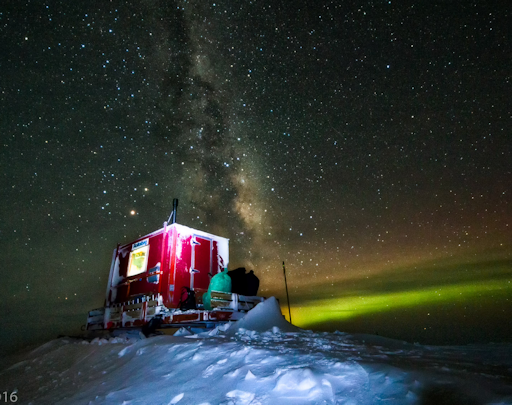
"I camped out in the field, enduring temperatures around -32°C to -34°C to witnessthis fantastic glow of green and purple," says photographer Greig Lawson. "This is at the site of an Emperor penguin colony. The calls of the birds in the background provided the soundtrack to the evening's photography!"
Lawson is a medical doctor working at the British Antarctic Survey's Halley Research Station. Located atop the Brunt Ice Shelf, a 130 meter thick slab of frozen water that floats atop the Weddell Sea, Halley is known for its studies of ozone, cosmic rays, and climate change. Lawson will be busy in the months ahead tending to the station's wintertime staff of 16. Hopefully, he'll have time send more pictures as geomagnetic storms paint their colors on Antarctic skies. Aurora alerts: text or voice