SOLAR SECTOR BOUNDARY CROSSING (UPDATED): On April 29th or 30th, Earth will cross a fold in the heliospheric current sheet--a vast wavy structure in interplanetary space separating regions of opposite magnetic polarity. This is called a "solar sector boundary crossing," and it could trigger geomagnetic activity around Earth's poles. NOAA forecasters estimate a 60% chance of G1-class geomagnetic storms when the crossing occurs. Aurora alerts: text or voice

SPACE LIGHTNING OVER TEXAS: High above Earth in the realm of meteors and noctilucent clouds, a strange and beautiful form of lightning dances at the edge of space. Researchers call the bolts "sprites." They are red, fleeting, and tend to come in bunches. Last night in Hawley, Texas, Kevin Palivec photographed a magnificent display over an advancing thunderstorm:
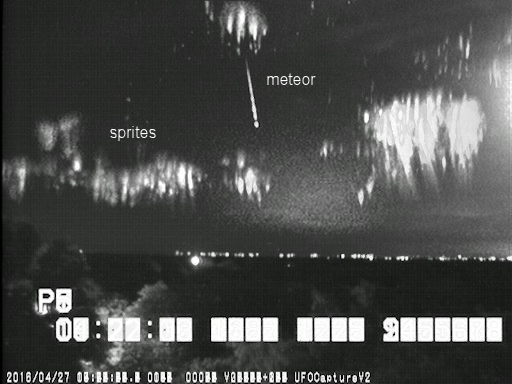
"Storms moving across Texas produce more than just rain,wind,hail and tornados!" says Palivec. "They also produce a lot of space lightning called sprites. This is a stacked image of all the sprites I caught over storms as they moved across Texas towards Dallas/FtWorth--with one meteor thrown in!"
Because sprites are associated with thunderstorms, they tend to occur in late spring and summer. Palivec's photo shows that sprite season is now underway.
"Sprites are a true space weather phenomenon," explains lightning scientist Oscar van der Velde of the Technical University of Catalonia, Spain. "They develop in mid-air very high above Earth's surface, around 80 km altitude, growing in both directions, first down, then up. An individual sprite lasts only around 5-50 milliseconds but a sequence of them can be seen to 'dance' over storm fronts for a much longer period of time."
Some researchers believe they are linked to cosmic rays: subatomic particles from deep space striking the top of Earth's atmosphere produce secondary electrons that, in turn, could provide the spark that triggers sprites.
Although sprites have been seen for at least a century, most scientists did not believe they existed until after 1989 when sprites were photographed by cameras onboard the space shuttle. Now "sprite chasers" routinely photograph sprites from their own homes. Give it a try!

PENGUINS SERENADE AURORAS: As northern summer approaches, the midnight skies of the Arctic Circle are no longer completely dark. Aurora season is therefore shifting from north to south. For the next four months or so, the velvety-dark skies of Antarctica are the perfect backdrop for auroras. Penguins on the Brunt Ice Shelf serenaded this display on April 16th:
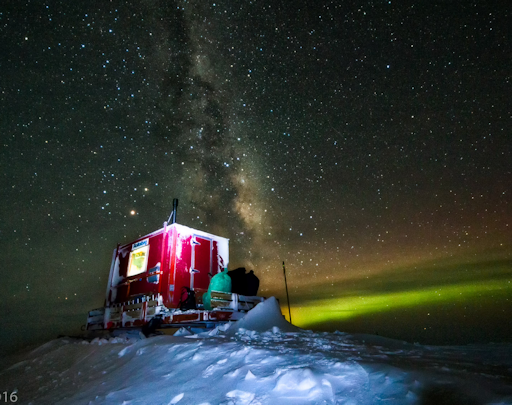
"I camped out in the field, enduring temperatures around -32°C to -34°C to witnessthis fantastic glow of green and purple," says photographer Greig Lawson. "This is at the site of an Emperor penguin colony. The calls of the birds in the background provided the soundtrack to the evening's photography!"
Lawson is a medical doctor working at the British Antarctic Survey's Halley Research Station. Located atop the Brunt Ice Shelf, a 130 meter thick slab of frozen water that floats atop the Weddell Sea, Halley is known for its studies of ozone, cosmic rays, and climate change. Lawson will be busy in the months ahead tending to the station's wintertime staff of 16. Hopefully, he'll have time send more pictures as geomagnetic storms paint their colors on Antarctic skies. Aurora alerts: text or voice
Realtime Space Weather Photo Gallery