SPACE ROSES FOR MOTHER'S DAY: Nothing says "Happy Mother's Day" quite like a red rose from the edge of space. Click here to see what we mean. There's still time to buy a space rose for your own mom. Order one now from Earth to Sky Calculus for delivery before May 8th. All proceeds support student space weather research.
POLAR MIRAGE OVER SAN FRANCISCO: Around the Arctic Circle, observers of the sunset sometimes witness a special kind of mirage: As the sun sinks into the waves of northern waters, the disk of the sun splits into horizontal slices. This is called the Novaya Zemlya Effect, first documented in 1597 by Dutch explorers sailing deep inside the Arctic Circle. Yesterday, photographer Mila Zinkova saw the same thing in San Francisco, California:

"At first the sunset appeared to be a common San Francisco mock mirage sunset, but then as the sunset progressed it developed characteristics of the Novaya Zemlya Effect," says Zinkova.
The Novaya Zemlya effect is a mirage that requires a temperature inversion layer hundreds of kilometers wide with strong internal temperature gradients. These conditions tend to occur in polar regions, but in this case it happened in the Bay Area.
"There were also some green flashes but because of the reddening of the atmosphere they were not very bright. Of course the best way to enjoy this remarkable sunset is to watch the video I filmed."
Realtime Space Weather Photo Gallery
SPRINGTIME AURORAS: On Saturday, April 30th, Earth crossed a fold in the heliospheric current sheet and entered a region of space filled with negative-polarity magnetic fields. This sparked an outburst of springtime auroras around the Arctic Circle. Todd Salat photographed the display from the shore of Lake Louise, Alaska:
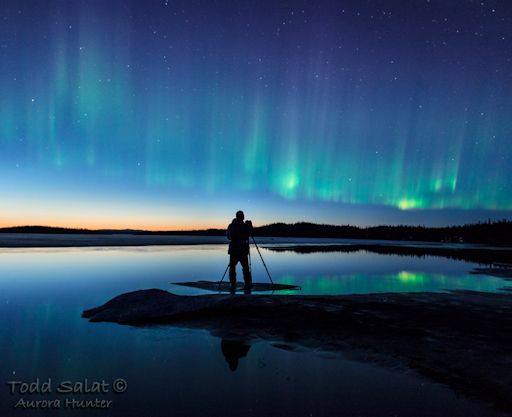
"I took this picture during the darkest part of the night on April 30, 2016, around 1:25 am," says Salat. "The auroras were reflecting beautifully from the surface of the lake during my self-portrait."
The orange glow in Salat's picture is caused by the Midnight Sun, just below the horizon. At this time of year, auroras have a hard time being seen at Arctic latitudes because of the persistent twilight. Nevertheless, Salat got a good shot.
"I keep thinking this is the end of the aurora season for high northern latitudes," he says, "but then I think of that infamous 1973 quote from baseball legend Yogi Berra, 'It ain't over till it's over.'"
Indeed, more auroras could be in the offing. NOAA forecasters estimate a 40% to 50% chance of G1-class geomagnetic storms on April 30th-May 1st as Earth moves into a weekend solar wind stream. Aurora alerts: text or voice

"SPACE LIGHTNING" OVER TEXAS: You know what comes out of the bottom of thunderstorms: lightning. On April 27th, Kevin Palivec of Hawley, Texas, saw something coming out of the top. "Storms moving across Texas produce more than just rain, wind, hail and tornadoes!" says Palivec. "They also produce a lot of space lightning called 'sprites.' This is a stacked image of all the sprites I caught over storms as they moved across Texas towards Dallas/Ft Worth--with one meteor thrown in!"
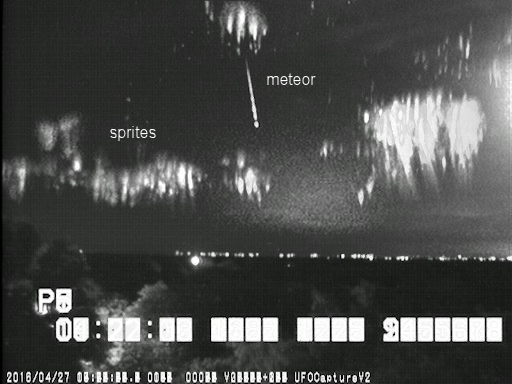
Because sprites are associated with thunderstorms, they tend to occur in late spring and summer. Palivec's photo shows that sprite season is now underway.
Sprites are a true space weather phenomenon, inhabiting the upper reaches of Earth's atmosphere alongside noctilucent clouds, meteors, and some auroras. Some researchers believe they are linked to cosmic rays: subatomic particles from deep space striking the top of Earth's atmosphere produce secondary electrons that, in turn, could provide the spark that triggers sprites.
"Sprites develop in mid-air very high above Earth's surface, around 80 km altitude, growing in both directions, first down, then up," says explains lightning scientist Oscar van der Velde of the Technical University of Catalonia, Spain. "An individual sprite lasts only around 5-50 milliseconds but a sequence of them can be seen to 'dance' over storm fronts for a much longer period of time."
Although sprites have been seen for at least a century, most scientists did not believe they existed until after 1989 when sprites were photographed by cameras onboard the space shuttle. Now "sprite chasers" routinely photograph sprites from their own homes. Give it a try!
