SPACE ROSES FOR MOTHER'S DAY: Nothing says "Happy Mother's Day" quite like a red rose from the edge of space. See? There's still time to buy a space rose for your own mom. Order one now from Earth to Sky Calculus for delivery before May 8th. All proceeds support student space weather research.
NEGATIVE MAGNETIC FIELDS SPARK AURORAS: For the past three days Earth has been passing through a region of interplanetary space filled with negative-polarity magnetic fields. This has caused intermittent geomagnetic storms and beautiful auroras around both poles. On May 2nd, Svante Sandström photographed this display over Västerlanda, Sweden:
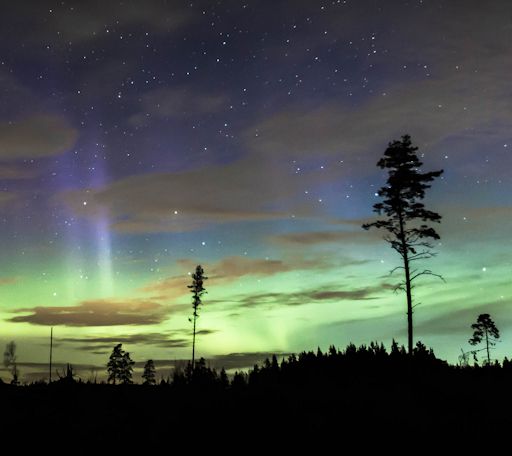
"The auroras and their movements were absolutely stunning," says Sandström.
"This could be the last performance of the season at our latitude," he adds. "Summer is coming, and the night skies are growing too bright for auroras."
Earth entered this aurora-friendly region of space on Saturday, April 30th, when we crossed through a fold in the heliospheric current sheet. Many people have never heard of the heliospheric current sheet. It is one of the biggest things in the solar system--a vast undulating system of electrical currents shaped like the skirt of a ballerina: picture. Earth dips in and out of it all the time. Currently, we are on the side of the current sheet containing negative-polarity magnetic fields. Such fields can open a crack in our planet's magnetosphere, allowing solar wind to pour in and fuel colorful displays.
During the current episode, Northern Lights have descended as far south as Michigan, while Southern Lights have ascended as far north as New Zealand. NOAA forecasters estimate a 25% chance of more storms tonight. Stay tuned. Aurora alerts: text or voice
"SPACE LIGHTNING" OVER THE CARRIBEAN: Sprite season is definitely underway. Only a few days after a widespread display appeared over Texas, more sprites have popped up near Puerto Rico. Frankie Lucena photographed them on May 1st from Cabo Rojo, PR:
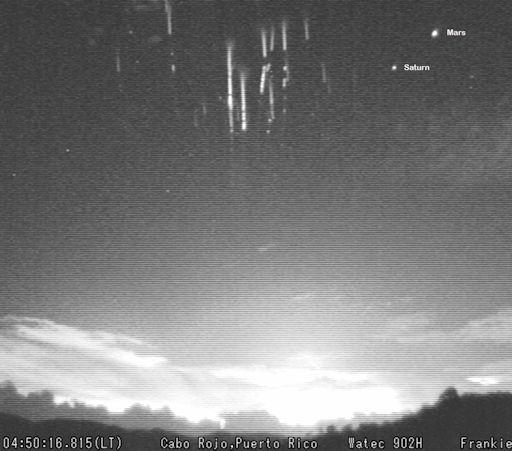
"They appeared right beside Mars and Saturn in the constellation Scorpius," says Lucena. "The sprites were over the Caribbean Sea just south of Cabo Rojo."
Sprites are an exotic form of upper atmospheric electricity, sometimes called "space lightning" because they reach altitudes associated with meteors, noctilucent clouds and auroras. Some researchers believe they are linked to cosmic rays: Subatomic particles from deep space striking the top of Earth's atmosphere produce secondary electrons that, in turn, could provide the spark that triggers sprites.
Lucena's ocean-going sprites are somewhat unusual. "A satellite study by Chen et al. 2008 (JGR) showed 49% of sprites to occur over land, 28% over the ocean and the remaining ones near the coastlines," explains lightning scientist Oscar van der Velde of the Technical University of Catalonia, Spain. "As oceans cover a greater area, this indicates sprites are more common over land-based storms."
Although sprites have been seen for at least a century, most scientists did not believe they existed until after 1989 when sprites were photographed by cameras onboard the space shuttle. Now "sprite chasers" routinely photograph sprites from their own homes. "They are easily detected by certain cameras," says van der Velde, "and if a storm is in the mood, you may record one every few minutes." Give it a try!
