METEORS FROM HALLEY'S COMET: Earth is entering a stream of debris from Halley's Comet, source of the annual eta Aquariid meteor shower. Forecasters expect the shower to peak on the nights around May 5th and 6th with 30+ meteors per hour. The best time to look, no matter where you live, is probably during the dark hours before sunrise on Friday. Got clouds? No problem. You can still experience this meteor shower by listening to it. Meteor radar echoes are being streamed live on Space Weather Radio.
SPHERICAL CAMERA AT THE EDGE OF SPACE: On May 1st, Spaceweather.com and students of Earth to Sky Calculus launched another space weather balloon to the stratosphere. Onboard was a spherical 360o camera. We've flown this camera before, but this time we flew it upside down. This arrangement afforded a better view of Earth's surface, unobstructed by a thermal pack which keeps the camera warm at the frigid edge of space. Here are the results:

The interactive image can be spun around and zoomed. Be sure to zoom in on the tiny red box; that's the payload capsule suspended 109,000 feet above Earth's surface. Inside the capsule is an array of X-ray/gamma-ray sensors for monitoring cosmic rays. Regular space weather balloon launches since 2014 have shown that cosmic radiation is intensifying--a trend we are monitoring closely. Spherical images are just icing on the cake of this important scientific research.
Bonus: The spherical camera also captured an interesting image en route to the stratosphere. This one shows virga (rain that evaporates before it hits the ground) over Crowley Lake, CA:

As before, click on the interactive image, then spin it around for the complete spherical experience.
Realtime Space Weather Photo Gallery
"SPACE LIGHTNING" OVER THE CARIBBEAN: Sprite season is definitely underway. Only a few days after a widespread display appeared over Texas, more sprites have popped up near Puerto Rico. Frankie Lucena photographed them on May 1st from Cabo Rojo:
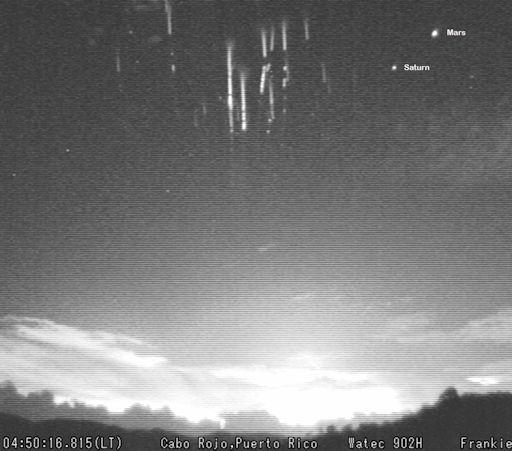
"They appeared right beside Mars and Saturn in the constellation Scorpius," says Lucena. "The sprites were over the Caribbean Sea just south of Cabo Rojo."
Sprites are an exotic form of upper atmospheric electricity, sometimes called "space lightning" because they reach altitudes associated with meteors, noctilucent clouds and auroras. Some researchers believe they are linked to cosmic rays: Subatomic particles from deep space striking the top of Earth's atmosphere produce secondary electrons that, in turn, could provide the spark that triggers sprites.
Lucena's ocean-going sprites are somewhat unusual. "A satellite study by Chen et al. 2008 (JGR) showed 49% of sprites to occur over land, 28% over the ocean and the remaining ones near the coastlines," explains lightning scientist Oscar van der Velde of the Technical University of Catalonia, Spain. "As oceans cover a greater area, this indicates sprites are more common over land-based storms."
Although sprites have been seen for at least a century, most scientists did not believe they existed until after 1989 when sprites were photographed by cameras onboard the space shuttle. Now "sprite chasers" routinely photograph sprites from their own homes. "They are easily detected by certain cameras," says van der Velde, "and if a storm is in the mood, you may record one every few minutes." Give it a try!
