MINOR GEOMAGNETIC STORM: A minor G1-class geomagnetic storm is underway on May 6th as Earth enters a high-speed stream of solar wind. NOAA forecasters say there is a 35% chance that intermittent storminess could continue through May 7th as the solar wind continues to blow. Aurora alerts: text, voice.

TRANSIT OF MERCURY: On Monday morning, May 9th, Mercury will pass directly between Earth and the sun, producing a rare transit visible from the Americas, Europe, Africa and much of Asia. According to NASA, this is what the tiny black disk of the innermost planet will look like as it crosses the solar disk:
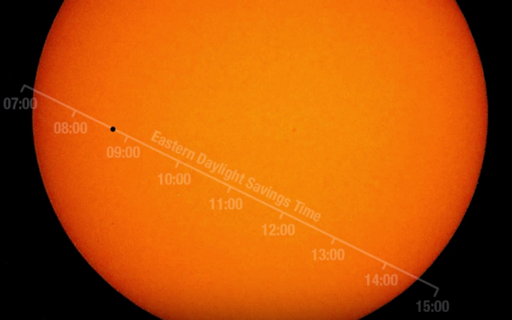
In the USA, the transit begins around 7:15 am eastern time. This means it begins before sunrise on the west coast, but that's no problem. The transit lasts for more than 7 hours, so Mercury will still be gliding across the solar disk when the sun comes up over places like California and Alaska. Everyone in the USA can experience the event.
Now for the bad news: Mercury is so small, you can't see the transit with the unaided eye. Safely-filtered solar telescopes are required. Don't have one? In that case, you can watch the transit online, broadcast live from the Coca-Cola Space Science Center in Columbus, Georgia. Also, NASA's Solar Dynamics Observatory will transmit images from space.
Mercury passes directly between the sun and Earth about 13 times every century. The last time it happened was ten years ago in 2006, meaning it is more rare than lunar and solar eclipses. If you miss Monday's transit, you'll have to wait until Nov.11, 2019, for the next one.
Realtime Space Weather Photo Gallery
SPHERICAL CAMERA AT THE EDGE OF SPACE: On May 1st, Spaceweather.com and students of Earth to Sky Calculus launched another space weather balloon to the stratosphere. Onboard was a spherical 360o camera. We've flown this camera before, but this time we flew it upside down. This arrangement afforded a better view of Earth's surface, unobstructed by a thermal pack which keeps the camera warm at the frigid edge of space. Here are the results:

The interactive image can be spun around and zoomed. Be sure to zoom in on the tiny red box; that's the payload capsule suspended 109,000 feet above Earth's surface. Inside the capsule is an array of X-ray/gamma-ray sensors for monitoring cosmic rays. Regular space weather balloon launches since 2014 have shown that cosmic radiation is intensifying--a trend we are monitoring closely. Spherical images are just icing on the cake of this important scientific research.
Bonus: The spherical camera also captured an interesting image en route to the stratosphere. This one shows virga (rain that evaporates before it hits the ground) over Crowley Lake, CA:

As before, click on the interactive image, then spin it around for the complete spherical experience.
Realtime Space Weather Photo Gallery