CHANCE OF STORMS: NOAA forecasters say there is a 65% chance of G1-class geomagnetic storms on May 9th when Earth enters a solar wind stream filled with negative-polarity magnetic fields. A display of high-latitude auroras is possible, especially in the southern hemisphere where visibility is improved by darkening autumn skies. Antarctic photographers, warm up your cameras! Aurora alerts: text, voice.

TRANSIT OF MERCURY: On Monday morning, May 9th, Mercury will pass directly between Earth and the sun, producing a rare transit visible from the Americas, Europe, Africa and much of Asia. According to NASA, this is what the tiny black disk of the innermost planet will look like as it crosses the solar disk:

In the USA, the transit begins around 7:15 am eastern time. This means it begins before sunrise on the west coast, but that's no problem. The transit lasts for more than 7 hours, so Mercury will still be gliding across the solar disk when the sun comes up over places like California and Alaska. Everyone in the USA can experience the event.
Indeed, people on almost every continent can see at least some of the transit. These global visibility maps are courtesy of ShadowandSubstance.com:
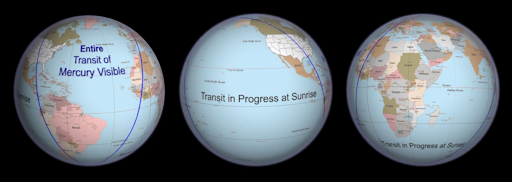
Now for the bad news: Mercury is so small, you can't see the transit with the unaided eye. Safely-filtered solar telescopes are required. Don't have one? In that case, you can watch the transit online, broadcast live from the Coca-Cola Space Science Center in Columbus, Georgia. Also, NASA's Solar Dynamics Observatory will transmit images from space.
Mercury passes directly between the sun and Earth about 13 times every century. The last time it happened was ten years ago in 2006, meaning it is more rare than lunar and solar eclipses. If you miss Monday's transit, you'll have to wait until Nov.11, 2019, for the next one.
Realtime Space Weather Photo Gallery
A FLOWER IN A DROPLET OF WATER: Photographers, the next time you want to take a great picture of a flower, don't point your lens at the bloom. Point it at the raindrops clinging to the stem. Mila Zinkova of San Francisco followed this procedure after a rainstorm on May 6th, and here is result:

"Raindrops provide some interesting photo opportunities because they act as inverting lenses," says Zinkova. "Images inside appear upside down."
A few weeks ago, Zinkova discovered you can fit an entire suspension bridge inside a raindrop. This photo captures the Golden Gate Bridge multiplied through the rain-splattered windshield of her car. "The fly in that image is not seen through a droplet, and thats why its orientation is normal," she explains.

Realtime Space Weather Photo Gallery