TRANSIT OF MERCURY: Today, May 9th, Mercury passed directly between Earth and the sun, producing a rare transit of Mercury's inky-black disk across the solar surface. Images of the event are pouring into our image gallery from around the world. Browse and enjoy!
STRONG GEOMAGNETIC STORM: For the past 24+ hours, Earth's magnetic field has been reverberating with geomagnetic storms. At their most intense on May 8th, G3-class storms sparked bright auroras around both poles, parts of four continents, and more than a half a dozen US states. In Antarctica, everything turned green:

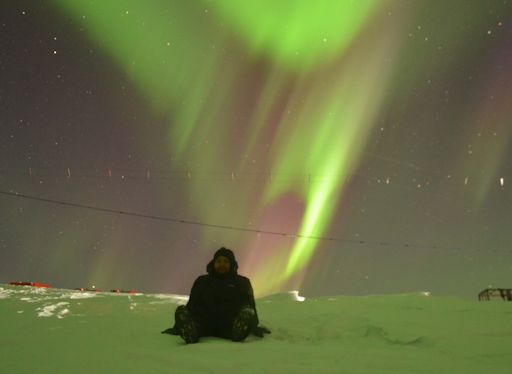
"The auroras were beautiful at Argentina's Belgrano II base in Antarctica," reports photographer Gabriel Saiquita, who has witnessed bright Southern Lights for two days in a row.
In the United States, auroras were sighted in Alaska, Washington, Idaho, Michigan, Montana, Minnesota, and even Arkansas.
The "Mother's Day Storms" of May 8th began when Earth crossed a fold in the heliospheric current sheet, entering a region of space filled with negative-polarity magnetic fields. Such fields easily link to Earth's magnetic field, opening a crack in our planet's magnetosphere. Solar wind pours in to fuel spectacular auroras.
Overall, this was the strongest episode of geomagnetic activity so far in 2016. The storms are subsiding now. NOAA forecasters estimate a 65% chance of minor G1-class storms on May 9th as Earth's magnetic environment returns to normal. Aurora alerts: text, voice.

DOUBLE SPACE WEATHER BALLOON LAUNCH: Yesterday, May 8th, Spaceweather.com and the students of Earth to Sky Calculus conducted a double-launch of space weather balloons. The two balloons, one released from Oregon and the other from California, flew into the strongest geomagnetic storm of 2016.
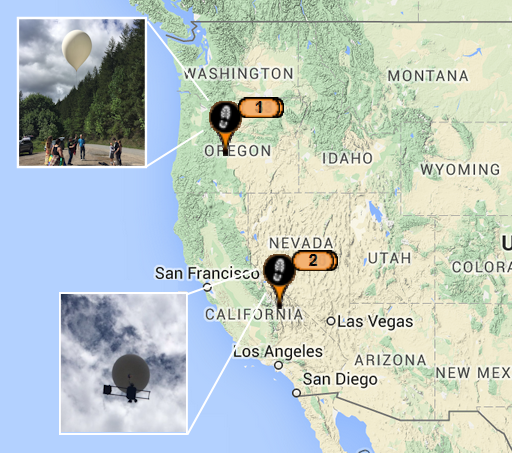
Each of the balloons carried a cosmic ray payload to the stratosphere, measuring atmospheric radiation from ground level to the edge of space during the G3-class storm. What effect does such a strong geomagnetic storm have on the upper atmosphere? And does Oregon receive more space radiation because of its higher magnetic latitude? These are just two of the questions we hope to answer.
The payloads have since parachuted back to Earth--one landing in the foothills of the Sierra Nevada mountains of California, and the other on the east side of the Cascade mountains near Bend, Oregon. Recovery teams will enter the wilderness on May 9th and bring back the data. Stay tuned!
Realtime Space Weather Photo Gallery