SUBSIDING GEOMAGNETIC STORM: Earth's magnetic field is quieting today following a strong geomagnetic storm on May 8th that took forecasters by surprise. The G3-class event sparked bright auroras around both poles, parts of four continents, and more than a half a dozen US states. Browse the aurora gallery for a recap. Aurora alerts: text, voice.

TRANSIT OF MERCURY + THE ISS: Around the world yesterday, thousands of astronomers photographed a rare transit of Mercury across the face of the sun. Only a few, however, caught the double transit. Theirry Legault was one of them. He photographed Mercury and the International Space Station crossing the solar disk at the same time:

"For a split second during Mercury's 7-hour transit, the ISS raced across the face of the sun over Philadelphia," explains Legault. "The complete video shows another unexpected guest as well."
One orbit of the ISS later, it happened again. Max Yang and John Zhou photographed a similar scene over Squamish, British Columbia: image.
Both groups used Calsky.org to help them predict the transits. To capture such a near-perfect alignment of the sun, Mercury, and the ISS, the observers had to locate their optics precisely within narrow corridors no more than 5 km wide and have their cameras running during a 0.6-second interval when the ISS passed by at 17,000 mph. No wonder only a handful of photographers managed to get the shot.
No ISS? No problem. Mercury transiting solo was beautiful, too. Browse the gallery for examples:
DOUBLE SPACE WEATHER BALLOON LAUNCH: Yesterday, May 8th, Spaceweather.com and the students of Earth to Sky Calculus conducted a double-launch of space weather balloons. The two balloons, one released from Oregon and the other from California, flew into the strongest geomagnetic storm of 2016.
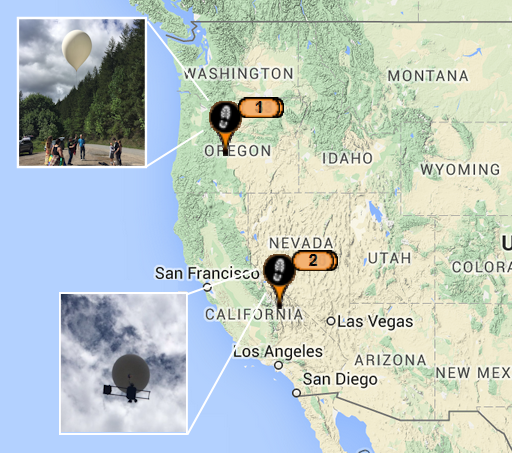
Each of the balloons carried a cosmic ray payload to the stratosphere, measuring atmospheric radiation from ground level to the edge of space during the G3-class storm. What effect does such a strong geomagnetic storm have on the upper atmosphere? And does Oregon receive more space radiation because of its higher magnetic latitude? These are just two of the questions we hope to answer.
The payloads have since parachuted back to Earth--one landing in the foothills of the Sierra Nevada mountains of California, and the other on the east side of the Cascade mountains near Bend, Oregon. Recovery teams entered the wilderness on May 9th and bring back the data. Stay tuned!
Realtime Space Weather Photo Gallery