LONG RANGE FORECAST: Geomagnetic activity is expected to remain low for the rest of the week. The next storms are possible on May 16th when Earth enters a stream of solar wind flowing from a coronal hole on the sun. High-latitude sky watchers should be alert for auroras at that time. Aurora alerts: text, voice.
SUPERIOR CONJUNCTION OF VENUS: Looking for Venus? Don't. You will only hurt your eyes. This month Venus is uncomfortably close to the sun. It soars overhead at local noon less than 7o away from the blinding solar disk. The Solar and Heliospheric Observatory (SOHO) is monitoring the close encounter using an opaque disk to block the glare:
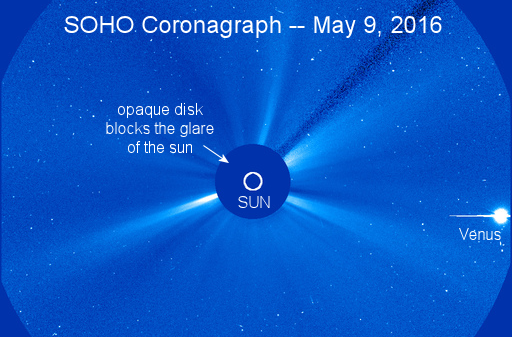
As seen from Earth, Venus will remain close to the sun for the next month and a half. A coronagraph such as the one on SOHO will be required to track the planet during this time. Dates of special interest include May 24th, when Venus, the sun, and the Pleiades star cluster form a triangle in the SOHO field of view, and June 6th, when Venus passes directly behind the body of the sun. Astronomers call the latter a "superior conjunction of Venus."
Still looking for Venus? Here it is.
Realtime Space Weather Photo Gallery
LOW LATITUDE AURORAS: On May 8th, the strongest geomagnetic storm of 2016 erupted when Earth entered a region of space filled with negative polarity magnetic fields. During the G3-class event, Northern Lights spilled across the Canadian border into the United States, descending to latitudes where auroras are rare indeed. Terrence Cook photographed the colorful glow of the storm from Kansas:

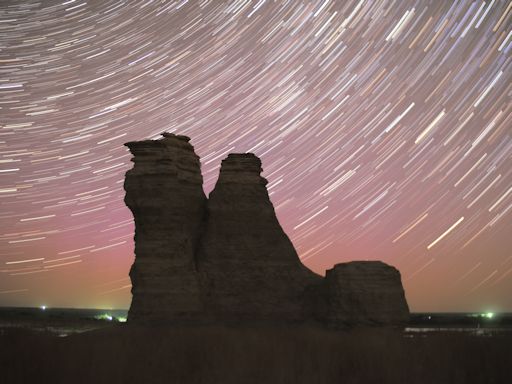
"After witnessing two tornadoes near Wray, Colorado, I continued driving east towards Colby, Kansas, when I noticed the aurora dancing over lightning to the north!" says Cook. "I stopped at Castle Rock for a photo shoot."
The auroras were barely visible to the naked eye, but they were an easy target for Cook's camera when he opened the shuttler for a long exposure.
Even further south, Brian Emfinger photographed the red rays of the geomagnetic storm from Arkansas: image. These are sometimes called "deep sky auroras" because they require photo settings akin to those used for faint objects like galaxies and nebulas.
Challenge to low-latitude astrophotographers: The next time there's a strong geomagnetic storm, open your shutters. The results may surprise you. Aurora alerts: text, voice.
Realtime Space Weather Photo Gallery
HANGING OUT WITH SUN HALOS: Northern summer is just weeks away. For people near the Arctic Circle, that means its time to absorb some long-overdue sunlight--or in this case, a sun halo:
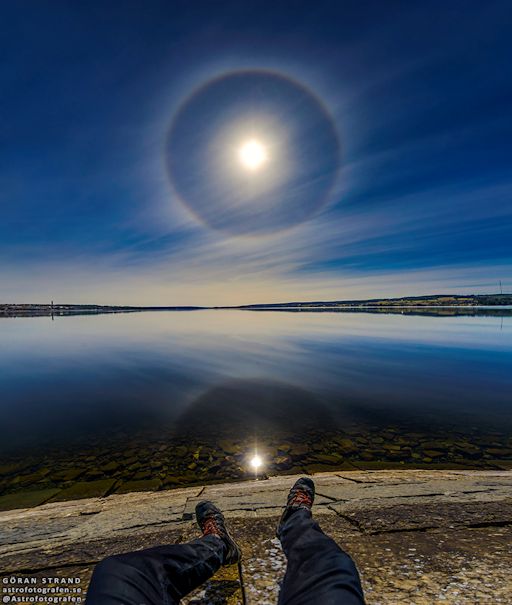
"Today, I've been hanging out with a beautiful reflected solar halo, the first halo for this summer season," says photographer Göran Strand of Östersund, Sweden.
Sun halos are caused by ice in high cirrus clouds. When sunlight refracts through hexagonal crystals, it forms a 22-degree ring of light as shown above. These crystals are present even during summer because the air 10 km high is always cold enough to freeze water.
The northern sun has risen. Let the hanging out begin!
Realtime Space Weather Photo Gallery