GEOMAGNETIC FORECAST: Geomagnetic activity is expected to remain low for the rest of the week. The next storms are possible on May 16th when Earth enters a stream of solar wind flowing from a coronal hole on the sun. High-latitude sky watchers should be alert for auroras at that time. Aurora alerts: text, voice.
EARTH'S MAGNETIC FIELD IS CHANGING: Anyone watching a compass needle point steadily north might suppose that Earth's magnetic field is a constant. It's not. Researchers have long known that changes are afoot. The north magnetic pole routinely moves, as much as 40 km/yr, causing compass needles to drift over time. Moreover, the global magnetic field has weakened 10% since the 19th century.
A new study by the European Space Agency's constellation of Swarm satellites reveals that changes may be happening even faster than previously thought. In this map, blue depicts where Earth's magnetic field is weak and red shows regions where it is strong:
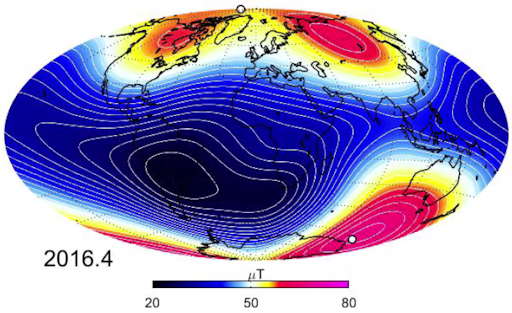
Data from Swarm, combined with observations from the CHAMP and Ørsted satellites, show clearly that the field has weakened by about 3.5% at high latitudes over North America, while it has strengthened about 2% over Asia. The region where the field is at its weakest – the South Atlantic Anomaly – has moved steadily westward and weakened further by about 2%. These changes have occured over the relatively brief period between 1999 and mid-2016.
Earth's magnetic field protects us from solar storms and cosmic rays. Less magnetism means more radiation can penetrate our planet's atmosphere. Indeed, high altitude balloons launched by Spaceweather.com routinely detect increasing levels of cosmic rays over California. Perhaps the ebbing magnetic field over North America contributes to that trend.
As remarkable as these changes sound, they're mild compared to what Earth's magnetic field has done in the past. Sometimes the field completely flips, with north and the south poles swapping places. Such reversals, recorded in the magnetism of ancient rocks, are unpredictable. They come at irregular intervals averaging about 300,000 years; the last one was 780,000 years ago. Are we overdue for another? No one knows.
Swarm is a trio of satellites equipped with vector magnetometers capable of sensing Earth's magnetic field all the way from orbital altitudes down to the edge of our planet's core. The constellation is expected to continue operations at least until 2017, and possibly beyond, so stay tuned for updates.
Realtime Space Weather Photo Gallery
WHAT ARE THESE CLOUDS? Every summer, something strange and wonderful happens high above the Earth's poles. Ice crystals form and cling to the smoky remains of meteors, forming electric-blue clouds with tendrils that ripple hypnotically against the sunset sky. The arrival of the first "noctilucent clouds" (NLCs) is always eagerly anticipated by high-latitude sky watchers. On May 10th in Scotland, Andy Stables may have spotted the first apparition of 2016:
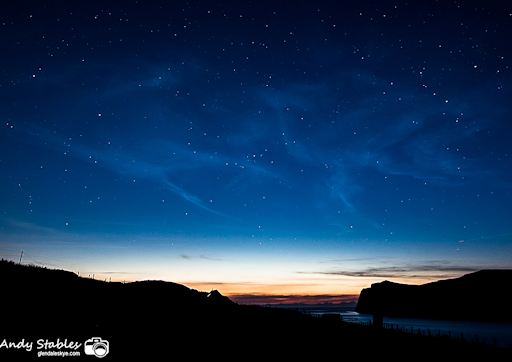
"I feel certain these are noctilucent clouds," says Stables, who is a veteran observer of NLCs, "but it is exceptionally early to capture them. It is the earliest I have ever managed to see them here on the Isle of Skye."
Normally, the first noctilucent clouds appear in late May or even early June. An apparition on May 10th makes one wonder if this could be something else--e.g., unusually high cirrus clouds catching the rays of the sun after sunset.
"I tried to convince myself that these might be cirrus clouds, but the sun was more than 12o below the horizon, which would make catching cirrus quite difficult," adds Stables.
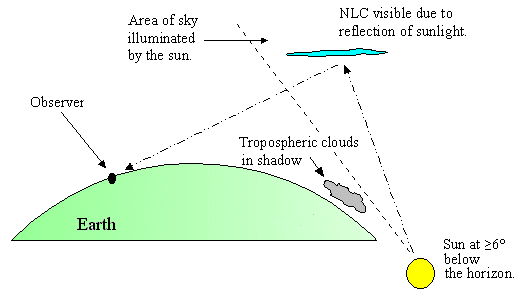
NLCs are Earth's highest clouds. Seeded by meteoroids, they float at the edge of space more than 80 km above the planet's surface. The clouds are very cold and filled with tiny ice crystals that glow electric-blue when they catch the rays of the setting sun.
The jury's still out on whether the clouds Stables saw are NLCs. NASA's AIM spacecraft, which monitors noctilucent clouds from Earth orbit, has not yet confirmed the sighting. Under certain lighting conditions, however, the human eye can be more sensitive to NLCs than instruments on the spacecraft, so they could be real.
Just in case, high-latitude sky watchers should be alert for NLCs in the evenings ahead. Observing tips: Look west 30 to 60 minutes after sunset when the sun has dipped 6o to 16o below the horizon. If you see luminous blue-white tendrils spreading across the sky, you've probably spotted a noctilucent cloud.
LOW LATITUDE AURORAS: On May 8th, the strongest geomagnetic storm of 2016 erupted when Earth entered a region of space filled with negative polarity magnetic fields. During the G3-class event, Northern Lights spilled across the Canadian border into the United States, descending to latitudes where auroras are rare. Terrence Cook photographed the colorful glow of the storm from Kansas:


"After witnessing two tornadoes near Wray, Colorado, I continued driving east towards Colby, Kansas, when I noticed the aurora dancing over lightning to the north!" says Cook. "I stopped at Castle Rock for a photo shoot."
The auroras were barely visible to the naked eye, but they were an easy target for Cook's camera when he opened the shuttler for a long exposure.
Even further south, Brian Emfinger photographed the red rays of the geomagnetic storm from Arkansas: image. These are sometimes called "deep sky auroras" because they require photo settings akin to those used for faint objects like galaxies and nebulas.
Challenge to low-latitude astrophotographers: The next time there's a strong geomagnetic storm, open your shutters. The results may surprise you. Aurora alerts: text, voice.