MINOR GEOMAGNETIC STORMS POSSIBLE THIS WEEK: NOAA forecasters estimate a 50% to 60% chance of minor G1-class geomagnetic storms on May 19-20 when Earth enters a stream of solar wind flowing from a coronal hole on the sun. High-latitude sky watchers should be alert for auroras, especially in the southern hemisphere where darkening autumn skies favor visibility. Aurora alerts: text, voice.


HOW TO SEE NASA'S GIANT SPACE BALLOON: On May 17th, NASA successfully launched a gigantic helium balloon from Wanaka, New Zealand, on a 100+ day mission to the stratosphere. The 19 million cubic foot behemoth is now floating over southern Australia where it is visible to the naked eye. "Last night, there were many calls across New South Wales about a strange glowing orb," reports Ray Pickard from the Bathurst Observatory Research Facility in Bathurst, Australia. "This image taken through my telescope shows it to be NASA's balloon launched from New Zealand."
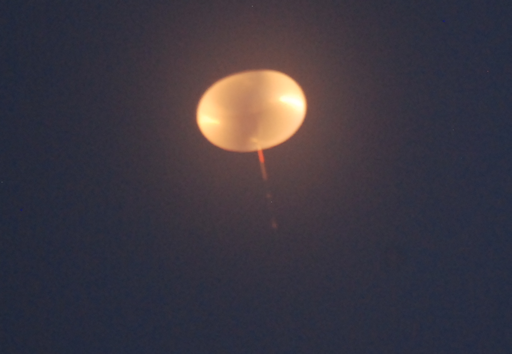
This is a test flight of NASA's super pressure balloon, which is capable of remaining at a near-constant altitude in the stratosphere for months. The previous record for such a balloon is 54 days. Engineers hope to shatter that mark by a factor of 2.
The balloon's payload includes an infrasound experiment developed by researchers ar the University of North Carolina. Previous balloon flights of their instrument have recorded low-frequency sounds in the stratosphere, some of which are believed to be new to science. Also onboard is NASA's Compton Spectrometer and Imager (COSI) gamma-ray telescope; among other things, it will study the origin of positrons in the Milky Way.
Currently, the balloon is 110,000 feet above Australia. Soon it will enter a winter stratospheric cyclone that will carry it eastward, circumnavigating the globe at southern mid-latitudes once every one to three weeks. People near the flight path over Australia, New Zealand, southern Africa and South America may be able to see the balloon as it passes by. The best time to look is around sunrise or sunset when the rays of the low-hanging sun paint the balloon golden-red against the dark twilight sky.
Where is the balloon now? Click here for real-time tracking.
MARS ALERT: On any night this week, when the clock strikes midnight, step outside and look south for a brilliant red "star" in the constellation Scorpius. It's Mars, approaching Earth for a close encounter at the end of the month. On May 17th, Alan Dyer photographed the Red Planet over Dinosaur Provincial Park in Alberta, Canada:

"Mars was unmistakable as the 'red planet' above the hoodoos and badlands of the Park," says Dyer. "Light from the waxing gibbous Moon provided the illumination."
Mars is not alone. Saturn and the red giant star Antares are there, too, forming a beautiful triangle with Mars as the third vertex. If you have a telescope, take a look. The rings of Saturn are easy to see through backyard optics. Ditto for the ruddy disk of Mars. The Red Planet is just finishing winter in its southern hemisphere, so be alert for a bright polar cap at the martian south pole.
Upcoming dates of interest include May 22nd when Mars is at opposition. In other words, it is opposite the sun in the sky; Mars rises at sunset and stays up all night long. Also on May 22nd, the full Moon passes by Mars, guiding novices right to the Red Planet: sky map. On May 30th, Mars makes its closest approach to Earth since 2003. Mark your calendar and enjoy the show!

Realtime Space Weather Photo Gallery
ATMOSPHERIC RADIATION--OREGON VS. CALIFORNIA: On May 8th, Spaceweather.com and the students of Earth to Sky Calculus simultaneously launched a pair of space weather balloons separated by 500 miles--one near Bend, Oregon, and the other near Bishop, California: map. Both balloons carried a payload of cosmic ray sensors to altitudes near 120,000 ft. Which state had more radiation in its atmosphere? The answer is Oregon:


The graph shows how radiation levels changed as the balloons ascended. From ground level to 40,000 feet, the two curves are almost indistinguishable. In terms of radiation, California and Oregon are much the same at altitudes where planes fly. Above 40,000 feet, however, the curves diverge. Peak radiation levels detected in the stratosphere over Oregon were more than 25% higher than California.
Some of this difference is to be expected. Oregon is closer to Earth's magnetic north pole where radiation levels are naturally higher. The natural difference between Oregon and California might have been amplified by space weather. At the time of the balloon launch, the strongest geomagnetic storm of 2016 (a G3-class event now known as the "Mother's Day Storm") was underway.

Could the Mother's Day Storm have been a factor? We will have to launch another pair of balloons to find out. A repeat of the experiment during quiet conditions should reveal the role of geomagnetic activity.
Balloon flights produce more than just good data. There's also spectacular photography. This shot shows the Cascade mountains of Oregon from 120,700 ft:

Sponsors of our research can have their pictures taken in front of this landscape. If you would like to sponsor our next Oregon-California balloon flight, currently scheduled for June, please contact Dr. Tony Phillips to get involved.