MAGNETIC STORM IGNORES FORECAST: Ignoring Spaceweather.com's forecast of a quiet weekend, a G1-class geomagnetic storm erupted during the early hours of May 21st. The brief disturbance occurred around 09:00 UT when Earth passed through a region of interplanetary space filled with negative polarity magnetic fields. Such fields open a crack in Earth's magnetosphere, allowing solar wind to pour in and fuel storms. Aurora alerts: text, voice.

MIDNIGHT SKY SHOW: Tonight, around midnight, step outside and look south. The full Moon is passing by Mars and Saturn, forming a luminous triangle in the constellation Scorpius. You won't need a sky map to find them, but just in case:

The Moon and planets are easy to see with the naked eye. Pay special attention to the intense rusty-red color of Mars and subtle golden hue of Saturn. The contrast is beautiful.
If you have a telescope, take a closer look. The rings of Saturn are easy to see through backyard optics. Ditto for the ruddy disk of Mars. The Red Planet is just finishing winter in its southern hemisphere, so be alert for a bright polar cap at the martian south pole.
This meeting in Scorpius occurs just 8 days before Mars makes its closest approach to Earth in a decade. Note the location of Mars tonight so you'll know where to look again on May 30th--the Night of the Red Planet!
Realtime Space Weather Photo Gallery
SNOOPY AT THE EDGE OF SPACE: On May 15th, Spaceweather.com and the students of Earth to Sky Calculus launched Snoopy to the edge of space--and set a high-altitude record for political campaigning. The high-altitude balloon flight was sponsored by Inyo County Supervisor Jeff Griffiths, who is running for re-election. Snoopy carried his campaign pin 115,700 feet:
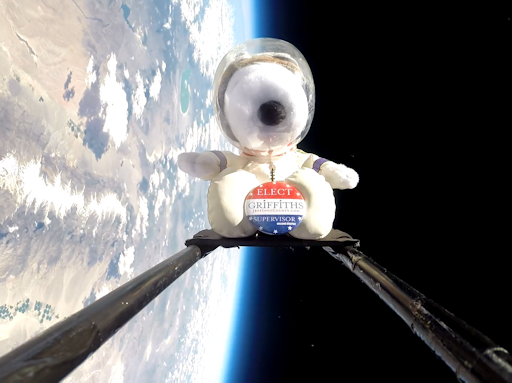
Griffith's generous donation to the students not only paid for his Edge of Space campaign ad, but also allowed us to continue our atmospheric radiation monitoring program. Valuable data were collected by cosmic ray sensors inside the payload, confirming our previous finding that cosmic rays are intensifying. Thanks, Jeff!
Readers, if you would like to send a small item or photo to space--and sponsor student research at the same time--the cost is $500. Contact Dr. Tony Phillips to book your flight.
RADIO STORM ON JUPITER: Earlier this week, there was a storm on Jupiter--a radio storm. Amateur radio astronomer Thomas Ashcraft recorded the event on May 17th using a shortwave radio telescope located in New Mexico. Click on the image to hear the whooshing sounds that emerged from his telescope's loudspeaker:
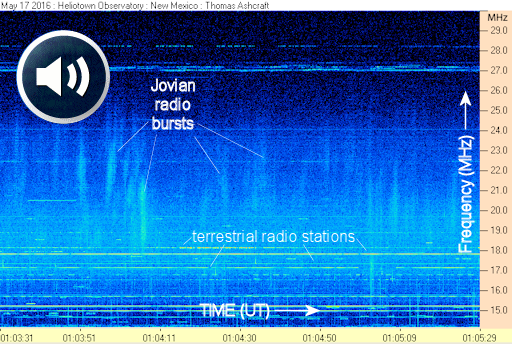
"This was a strong storm," says Ashcraft. "The audio recording captures the sounds I heard during one minute around 01:04 UT."
Jupiter's radio storms are caused by natural radio lasers in the planet's magnetosphere that sweep past Earth as Jupiter rotates. Electrical currents flowing between Jupiter's upper atmosphere and the volcanic moon Io can boost these emissions to power levels easily detected by ham radio antennas on Earth. Jovian "S-bursts" (short bursts) and "L-bursts" (long bursts) mimic the sounds of woodpeckers, whales, and waves crashing on the beach. Here are a few audio samples: S-bursts, S-bursts (slowed down 128:1), L-Bursts
Now is a good time to listen to Jupiter's radio storms. The giant planet is only two months past opposition (closest approach to Earth), and it is high in the sky at sunset. NASA's Radio Jove Project explains how to build your own receiver.