THE SUN IS FLATLINING: With no sunspots actively flaring, the sun's X-ray output is flatlining. This situation is likely to continue. NOAA forecasters say there is no more than a 1% chance of strong flares for the next 3 days. Solar flare alerts: text, voice.

PHOTOGENIC SUNSPOT: Usually when a sunspot is really big, it is also really active. Not so for sunspot AR2546, a behemoth big enough to swallow Earth yet at the same time stubbornly quiet. Since it appeared 10 days ago, AR2546 has not unleashed a single significant solar flare. On the bright side, it's photogenic. Piotr Wieczorek sends this picture from Jantar, Poland:

"As the sun rose above the Gulf of Danzig on May 22nd, the morning clouds acted as a natural filter, allowing me to photograph this big sunspot," says Wieczorek.
Wieczorek's photo also captured a mirage. Note the melted shape of the solar disk just behind the passing birds. This is caused by a layer of warmer and less dense air close to the water's surface. Many photographers have captured similar images in recent days. Browse the photo gallery for examples.
Caution: Even when the sun is dimmed by low-hanging clouds or haze, it can still be dangerously bright. If you chose to photograph the low sun, as Wieczorek did, use the camera's LCD screen for safe viewfinding. Never look into the eyepiece of an unfiltered camera or telescope when the sun is in the field of view.
Realtime Space Weather Photo Gallery
SNOOPY AT THE EDGE OF SPACE: On May 15th, Spaceweather.com and the students of Earth to Sky Calculus launched Snoopy to the edge of space--and set a high-altitude record for political campaigning. The high-altitude balloon flight was sponsored by Inyo County Supervisor Jeff Griffiths, who is running for re-election. Snoopy carried his campaign pin 115,700 feet:
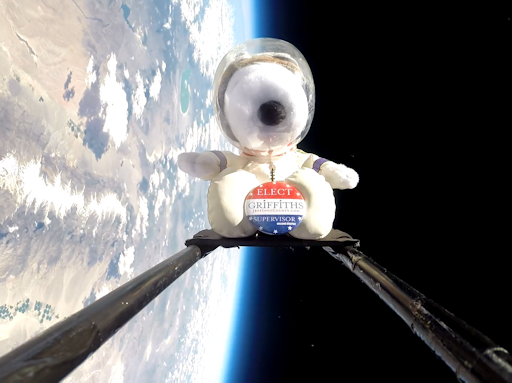
Griffith's generous donation to the students not only paid for his Edge of Space campaign ad, but also allowed us to continue our atmospheric radiation monitoring program. Valuable data were collected by cosmic ray sensors inside the payload, confirming our previous finding that cosmic rays are intensifying. Thanks, Jeff!
Readers, if you would like to send a small item or photo to space--and sponsor student research at the same time--the cost is $500. Contact Dr. Tony Phillips to book your flight.
RADIO STORM ON JUPITER: Earlier this week, there was a storm on Jupiter--a radio storm. Amateur radio astronomer Thomas Ashcraft recorded the event on May 17th using a shortwave radio telescope located in New Mexico. Click on the image to hear the whooshing sounds that emerged from his telescope's loudspeaker:
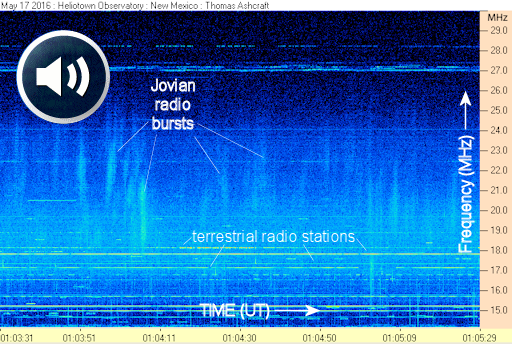
"This was a strong storm," says Ashcraft. "The audio recording captures the sounds I heard during one minute around 01:04 UT."
Jupiter's radio storms are caused by natural radio lasers in the planet's magnetosphere that sweep past Earth as Jupiter rotates. Electrical currents flowing between Jupiter's upper atmosphere and the volcanic moon Io can boost these emissions to power levels easily detected by ham radio antennas on Earth. Jovian "S-bursts" (short bursts) and "L-bursts" (long bursts) mimic the sounds of woodpeckers, whales, and waves crashing on the beach. Here are a few audio samples: S-bursts, S-bursts (slowed down 128:1), L-Bursts
Now is a good time to listen to Jupiter's radio storms. The giant planet is only two months past opposition (closest approach to Earth), and it is high in the sky at sunset. NASA's Radio Jove Project explains how to build your own receiver.