SOLAR SECTOR BOUNDARY CROSSING: Late on May 25th, Earth will cross a fold in the heliospheric current sheet and enter a region of space filled with negative polarity magnetic fields. Such fields can open a crack in Earth's magnetosphere, allowing solar wind to pour in and fuel geomagnetic disturbances. According to NOAA forecasters, the odds of a G1-class storm is 20% to 30%. Aurora alerts: text, voice.

WAITING FOR NOCTILUCENT CLOUDS: Every year in late May, noctilucent clouds (NLCs) gather over Earth's north pole where they remain, rippling hypnotically, until the end of Arctic summer. NLCs are, by far, Earth's highest clouds. Seeded by meteoroids, they float in a thin layer ~83 km above the planet's surface. With the beginning of the season upon us, NASA's AIM spacecraft is monitoring the Arctic for signs of electric blue:

This is called a "daily daisy." It assembles scans from AIM's Cloud Imaging and Particle Size (CIPS) instrument into an ensemble picture of the Arctic. Noctilucent clouds would appear as wispy filaments criss-crossing the Arctic Circle. You can see the daily daisy updated every 24 hours right here on Spaceweather.com.

So far AIM's daily daisy is empty--no NLCs. There has been one ground-based sighting that suggests the season might already be underway. We will know for sure when AIM spots the first Arctic NLCs of 2016 from space.
Realtime Noctilucent Cloud Photo Gallery
POLAR MESOSPHERIC SUMMERTIME ECHOS: Noctilucent clouds aren't the only sign of Arctic summer. So are polar mesospheric summertime echos (PMSEs). Arctic researchers who monitor VHF radio receivers sometimes pick up late night signals from distant transmitters. These strange "echos" occur during the months from May through August, the same as noctilucent cloud season. On May 14th, Rob Stammes of Laukvik, Lofoten, Norway, may have recorded the first PMSEs of 2016:

"I use my VHF receiving system generally for signals from auroras and meteors," says Stammes. "This couldn't have been auroras, because aurora activity was low. Plus, there is a big difference between the sound from aurora echoes and the sound of other reflection mechanisms. This event was much more like a PMSE, which I have detected many times in previous seasons."
PMSEs are radio waves reflection from an altitude of 80 km to 90 km. That part of Earth's upper atmosphere is called the "mesosphere." It is, coincidentally, the same place noctilucent clouds are found. The exact cause of PMSEs is not yet known; theorists have proposed explanations ranging from steep electron density gradients and "dressed aerosols" to gravity waves and turbulence. The echoes are often accompanied by visible NLCs, but not always.
Arctic summer is coming. Stay tuned for more PMSEs.
Realtime Space Weather Photo Gallery
SNOOPY AT THE EDGE OF SPACE: On May 15th, Spaceweather.com and the students of Earth to Sky Calculus launched Snoopy to the edge of space--and set a high-altitude record for political campaigning. The high-altitude balloon flight was sponsored by Inyo County Supervisor Jeff Griffiths, who is running for re-election. Snoopy carried his campaign pin 115,700 feet:
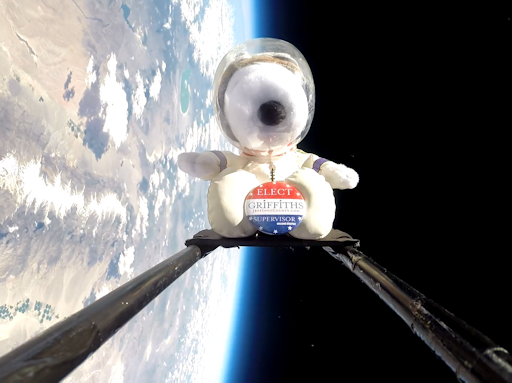
Griffith's generous donation to the students not only paid for his Edge of Space campaign ad, but also allowed us to continue our atmospheric radiation monitoring program. Valuable data were collected by cosmic ray sensors inside the payload, confirming our previous finding that cosmic rays are intensifying. Thanks, Jeff!
Readers, if you would like to send a small item or photo to space--and sponsor student research at the same time--the cost is $500. Contact Dr. Tony Phillips to book your flight.