CHANCE OF MINOR STORMS: NOAA forecasters estimate a 40% chance of minor G1-class geomagnetic storms on May 27th when Earth enters a high-speed stream of solar wind. High-latitude sky watchers should be alert for auroras, especially in the southern hemisphere where darkening autumn skies favor visibility of faint lights. Aurora alerts: text, voice.

SPRITES (AND SOMETHING MORE) OVER OKLAHOMA: On May 23rd, an enormous swarm of sprites flickered and danced across the top of a thunderstorm in Oklahoma. Almost 400 miles away in New Mexico, amateur astronomer Thomas Ashcraft trained his cameras on the display. He captured the sprites--and something more:
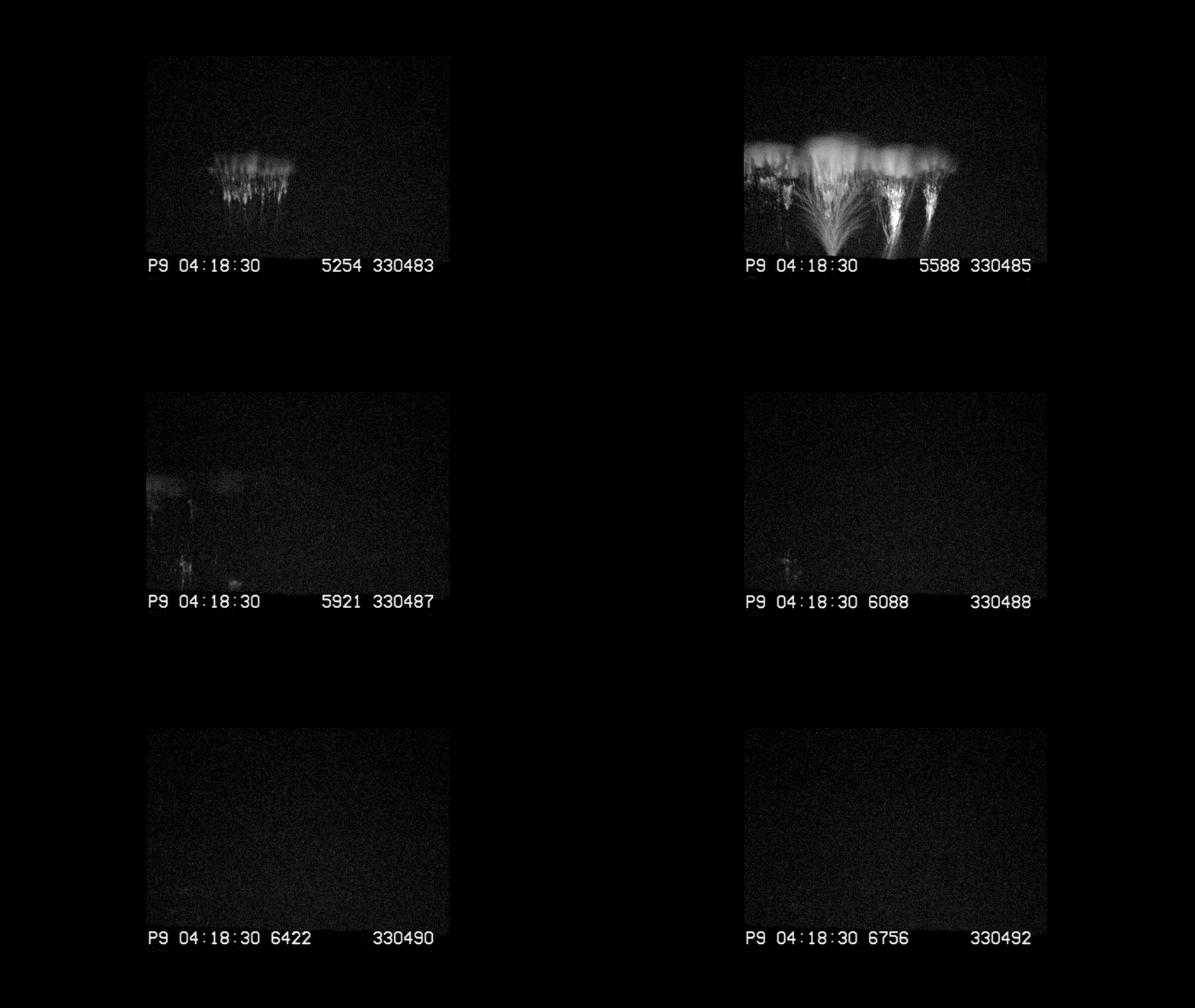
"Note the dendritic upward spray in the midst of the sprite cluster," points out Ashcraft. "That is a possible 'pop-through gigantic jet'--a rare event."
Ashcraft has posted a video of the event with VLF-ELF radio emissions he recorded as a soundtrack. Turn up the volume: "The deep bass sound of the lightning stroke sounds like a distant shotgun blast in the night," he says.
What is a pop-through gigantic jet? Lightning scientist Oscar van der Velde of the Technical University of Catalonia explains: "A cluster of sprites can actually warp Earth's ionosphere, bringing it down from its usual altitude of 90 km to only 40 km." This sets the stage for the jet.
"The sprite cluster triggers an upward-directed discharge which in the past received fancy names as 'troll' or 'palm tree'," says van der Velde. "A satellite-based study by Taiwanese researchers in 2012 found them similar to gigantic jets--large isolated discharges reaching from the thundercloud toward the ionosphere. In case of a 'pop-through gigantic jet,' the lowering of the ionosphere is not uniform and the jet may then reach higher than the bottom tendrils of the sprite."
Although sprites have been seen for at least a century, most scientists did not believe they existed until after 1989 when sprites were photographed by cameras onboard the space shuttle. Now "sprite chasers" routinely photograph sprites--and more!--from their own homes. "They are easily detected by certain cameras," says van der Velde, "and if a storm is in the mood, you may record one every few minutes." Give it a try!

SPACE BEARS MAKE GOOD GRADUATION GIFTS: Around the USA, high school seniors are preparing to receive their diplomas. Nothing says "you're on your way up!" better than a graduation gift from the Edge of Space. On May 25th, the students of Earth to Sky Calculus flew a family of "graduation grizzlies" 27 km (90,000 feet) above Earth's surface:
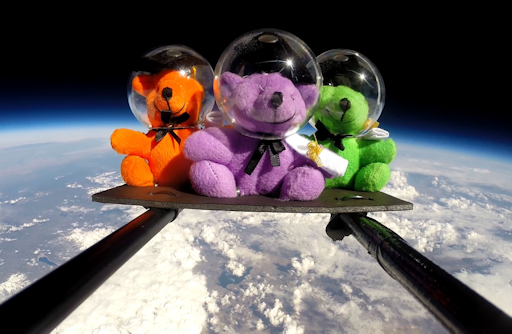
Outfitted with space helmets and a diploma, the intrepid Ursidae survived cosmic rays, ultra-low temperatures, and the near-vacuum of the stratosphere. For $49.95 you can have one of these bears along with a unique Graduation card showing the bears floating at the top of Earth's atmosphere. Buy one now.
Sales of the bears support student space weather research. In fact, the bears pictured above were hitchhiking on a payload equipped with radiation sensors. We send the sensors to the stratosphere every week to monitor increasing levels of cosmic rays. Visit the Earth to Sky store to support this crowd-funded research.
FEAR AND DREAD AROUND MARS: The moons of Mars are so small, some astronomers believe they are captured asteroids. Named Phobos and Deimos (Fear and Dread), the diminutive satellites average 17 km in diameter and are rarely seen in pictures of the Red Planet. On May 24th, astrophotographer Dennis Simmons of Brisbane, Australia, attempted to capture both. Rate of success: 100%.
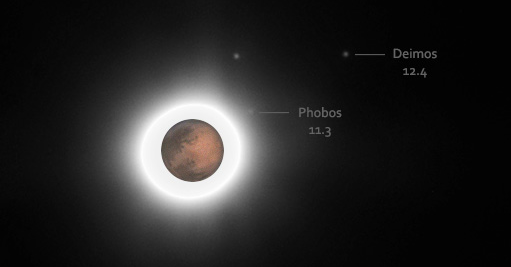
Mars shines 242,000 times brighter than Phobos and 741,000 times brighter than Deimos. The two moons are easily lost in the glare. "Deimos was relatively easy, but Phobos had to be gently teased out of the data," says Simmons, who used a 9 inch Celestron telescope.
This is a good time for astrophotographers to seek Fear and Dread. Why? Because Mars is unusually close to Earth. On May 30th, the two planets will be only 47 million miles apart--the closest they've been since 2005. This proximity not only boosts the apparent brightness of the tiny moons, but also increases their angular separation from Mars. Browse the gallery for sightings.
Realtime Space Weather Photo Gallery
Realtime Noctilucent Cloud Photo Gallery