MEMORIAL DAY STORM? NOAA forecasters estimate a 55% chance of G1-class geomagnetic storms on May 30th when Earth enters a stream of high-speed solar wind. Magnetic fields in the stream are thought to have a negative polarity ("negative Bz"). Such fields can open a crack in Earth's magnetosphere, allowing solar wind to pour in and fuel auroras. Aurora alerts: text, voice.

NOCTILUCENT CLOUD SEASON BEGINS: It's official. The 2016 season for noctilucent clouds is underway. NASA's AIM spacecraft spotted them on May 24th, and now observers on the ground are seeing them, too. Andy Stables sends this picture from Milovaig on the Isle of Skye, Scotland:

"The wispy electric-blue clouds appeared near midnight on May 27th," says Staples.
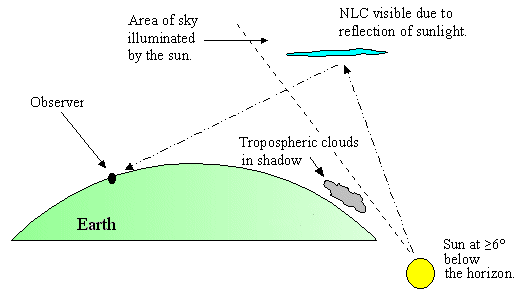
NLCs are Earth's highest clouds. Seeded by meteoroids, they float at the edge of space more than 80 km above the planet's surface. The clouds are very cold and filled with tiny ice crystals. When sunbeams hit those crystals, they glow electric-blue.
Noctilucent clouds first appeared in the 19th century after the eruption of super-volcano Krakatoa. At the time, people thought the clouds were caused by the eruption, but long after Krakatoa's ash settled, the clouds remained. In those days, NLCs were a polar phenomenon confined mainly to the Arctic. In recent years they have intensified and spread with sightings as far south as Utah and Colorado. Some researchers believe the intensification is a sign of climate change.
Early-season NLCs are always found at high-latitudes--e.g., Canada, the British isles, Siberia and Scandinavia. To people in those areas, we offer the following observing tips: Look west 30 to 60 minutes after sunset when the sun has dipped 6o to 16o below the horizon. If you see luminous blue-white tendrils spreading across the sky, you may have spotted a noctilucent cloud.
Realtime Noctilucent Cloud Photo Gallery
SPACE BEARS MAKE GOOD GRADUATION GIFTS: Around the USA, high school seniors are preparing to receive their diplomas. Nothing says "you're on your way up!" better than a graduation gift from the Edge of Space. On May 25th, the students of Earth to Sky Calculus flew a family of "graduation grizzlies" 27 km (90,000 feet) above Earth's surface:

Outfitted with space helmets and a diploma, the intrepid Ursidae survived cosmic rays, ultra-low temperatures, and the near-vacuum of the stratosphere. For $49.95 you can have one of these bears along with a unique Graduation card showing the bears floating at the top of Earth's atmosphere. Buy one now.
Sales of the bears support student space weather research. In fact, the bears pictured above were hitchhiking on a payload equipped with radiation sensors. We send the sensors to the stratosphere every week to monitor increasing levels of cosmic rays. Visit the Earth to Sky store to support this crowd-funded research.
Realtime Space Weather Photo Gallery
SPRITES (AND SOMETHING MORE) OVER OKLAHOMA: On May 23rd, an enormous swarm of sprites flickered and danced across the top of a thunderstorm in Oklahoma. Almost 400 miles away in New Mexico, amateur astronomer Thomas Ashcraft trained his cameras on the display. He captured the sprites--and something more:

"Note the dendritic upward spray in the midst of the sprite cluster," points out Ashcraft. "That is a possible 'pop-through gigantic jet'--a rare event."
Ashcraft has posted a video of the event with VLF-ELF radio emissions he recorded as a soundtrack. Turn up the volume: "The deep bass sound of the lightning stroke sounds like a distant shotgun blast in the night," he says.
What is a pop-through gigantic jet? Lightning scientist Oscar van der Velde of the Technical University of Catalonia explains: "A cluster of sprites can actually warp Earth's ionosphere, bringing it down from its usual altitude of 90 km to only 40 km." This sets the stage for the jet.
"The sprite cluster triggers an upward-directed discharge which in the past received fancy names as 'troll' or 'palm tree'," says van der Velde. "A satellite-based study by Taiwanese researchers in 2012 found them similar to gigantic jets--large isolated discharges reaching from the thundercloud toward the ionosphere. In case of a 'pop-through gigantic jet,' the lowering of the ionosphere is not uniform and the jet may then reach higher than the bottom tendrils of the sprite."
Although sprites have been seen for at least a century, most scientists did not believe they existed until after 1989 when sprites were photographed by cameras onboard the space shuttle. Now "sprite chasers" routinely photograph sprites--and more!--from their own homes. "They are easily detected by certain cameras," says van der Velde, "and if a storm is in the mood, you may record one every few minutes." Give it a try!
