CLOSE ENCOUNTER WITH MARS:Today, May 30th, Mars and Earth have converged for their closest encounter in a decade. The two worlds are only 47 million miles apart. Look south after dark. The Red Planet is shining like a bright burnt-orange star in the constellation Scorpius: sky map.

AMATEUR ASTRONOMER PHOTOGRAPHS BEAM: There's a new room on the International Space Station. NASA inflated it on Saturday. The Bigelow Expandable Activity Module (BEAM) was filled with air by astronaut Jeff Williams as the ISS flew over the south Pacific, kicking off an experiment to learn how inflatable habitats perform in a microgravity environment. "I think I am the first amateur astronomer to photograph BEAM from Earth," says Philip Smith, who sends these before-and-after images from Manorville, New York:

"Using a backyard telescope, I tracked the ISS as it passed overhead on May 26th (before inflation) and May 28th (after)," says Smith. "The new addition was clearly visible in my images."
"The Bigelow Aerospace-built BEAM is a prototype space habitat for future space stations, moon colonies and moon bases," he adds. "I am glad to be a small part of that history."
BEAM will remain attached to station for a two-year test period. Astronauts will not occupy the new room, but they will enter from time to time and monitor its performance. For more information about BEAM, visit: www.nasa.gov/beam.
Realtime Space Weather Photo Gallery
CHANCE OF STORMS ON MEMORIAL DAY: NOAA forecasters estimate a 55% chance of minor G1-class geomagnetic storms on May 30th when Earth enters a high-speed stream solar wind flowing from this coronal hole:


Coronal holes are places in the sun's atmosphere where the magnetic field opens up and allows solar wind to escape. When solar wind leaves the sun, it carries some of the sun's magnetic field with it to Earth. This is key: Magnetic fields in the emerging stream have a negative polarity ("negative Bz"). Such fields can pry open a crack in Earth's magnetosphere, allowing solar wind to pour in and fuel geomagnetic storms.
High-latitude sky watchers should be alert for auroras on May 30th, especially in the southern hemisphere where darkening autumn skies favor visibility of faint lights. Aurora alerts: text, voice.
SPACE BEARS MAKE GOOD GRADUATION GIFTS: Around the USA, high school seniors are preparing to receive their diplomas. Nothing says "you're on your way up!" better than a graduation gift from the Edge of Space. On May 25th, the students of Earth to Sky Calculus flew a family of "graduation grizzlies" 27 km (90,000 feet) above Earth's surface:
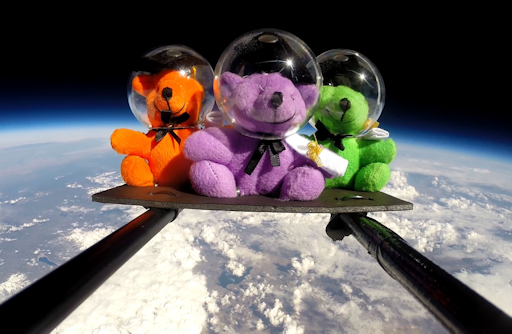
Outfitted with space helmets and a diploma, the intrepid Ursidae survived cosmic rays, ultra-low temperatures, and the near-vacuum of the stratosphere. For $49.95 you can have one of these bears along with a unique Graduation card showing the bears floating at the top of Earth's atmosphere. Buy one now.
Sales of the bears support student space weather research. In fact, the bears pictured above were hitchhiking on a payload equipped with radiation sensors. We send the sensors to the stratosphere every week to monitor increasing levels of cosmic rays. Visit the Earth to Sky store to support this crowd-funded research.
Realtime Space Weather Photo Gallery
Realtime Noctilucent Cloud Photo Gallery