SOLAR WIND HAS LITTLE EFFECT: As predicted, Earth passed through a stream of fast-moving solar wind on May 30th. The encounter did little to stoke geomagnetic activity, however, because magnetic fields in the stream did not make a good connection to our planet. NOAA forecasters have downgraded the odds of a geomagnetic storm on May 31st to only 30%, waning further to 15% by June 2nd. Aurora alerts: text, voice.
AMATEUR ASTRONOMER PHOTOGRAPHS BEAM: There's a new room on the International Space Station. NASA inflated it Saturday. The Bigelow Expandable Activity Module (BEAM) was filled with air by astronaut Jeff Williams as the ISS flew over the south Pacific, kicking off an experiment to learn how inflatable habitats perform in a microgravity environment. "I think I am the first amateur astronomer to photograph BEAM from Earth," says Philip Smith, who sends these before-and-after images from Manorville, New York:

"Using a backyard telescope, I tracked the ISS as it passed overhead on May 26th (before inflation) and May 28th (after)," says Smith. "The new addition was clearly visible in my images."
"The Bigelow Aerospace-built BEAM is a prototype space habitat for future space stations, moon colonies and moon bases," he adds. "I am glad to be a small part of that history."
BEAM will remain attached to station for a two-year test period. Astronauts will not occupy the new room, but they will enter from time to time and monitor its performance. For more information about BEAM, visit: www.nasa.gov/beam.
Realtime Space Weather Photo Gallery
STRANGE SUNSET: On the evening of May 26th, Michelle Bertnick stood on a beach near Fort Bragg, California, overlooking the Pacific Ocean. As the sun set behind the waves, something strange happened, and this was just the beginning:

Atmospheric optics expert Les Cowley explains: "Bertnick witnessed a strange miraged sunset made by several strong temperature inversion layers stacked unusually high above the ocean. Usually the inversions (warmer air over colder) hug the sea and mirage the lower part of the sun into slices. In this case, the inversions 'copied' a slice of the sun and 'pasted' it above the 'real' sun. Each inversion layer seems to have copied the same bit to give the rectangular shape."
After this rectangular apparition, something else happened. "There was a wonderful green flash (photo)" says Bertnick. "It started very bright and I had just enough time to catch a few shots before it went away! I have tried to catch a green flash at sunset for a long time, and this one took me by surprise."

"Sunset mirages and green flashes are frequent along the California coast," adds Cowley." They are made by the cold offshore current overlain by warm air from inland. Look out for them!"
SPACE BEARS MAKE GOOD GRADUATION GIFTS: Around the USA, high school seniors are preparing to receive their diplomas. Nothing says "you're on your way up!" better than a graduation gift from the Edge of Space. On May 25th, the students of Earth to Sky Calculus flew a family of "graduation grizzlies" 27 km (90,000 feet) above Earth's surface:
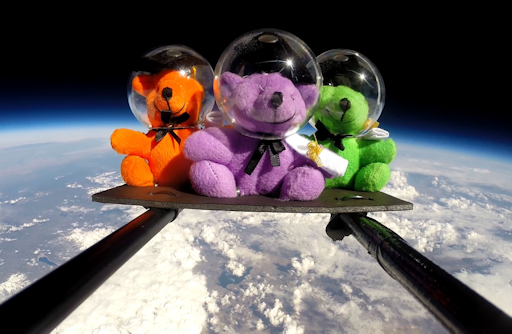
Outfitted with space helmets and a diploma, the intrepid Ursidae survived cosmic rays, ultra-low temperatures, and the near-vacuum of the stratosphere. For $49.95 you can have one of these bears along with a unique Graduation card showing the bears floating at the top of Earth's atmosphere. Buy one now.
Sales of the bears support student space weather research. In fact, the bears pictured above were hitchhiking on a payload equipped with radiation sensors. We send the sensors to the stratosphere every week to monitor increasing levels of cosmic rays. Visit the Earth to Sky store to support this crowd-funded research.
Realtime Noctilucent Cloud Photo Gallery