GEOMAGNETIC STORM: A minor G1-class geomagnetic storm is underway on June 5th as Earth enters a stream of fast-moving solar wind. High-latitude sky watchers should be alert for auroras,especially in the southern hemisphere where darkening autumn skies favor visibility. Aurora alerts: text, voice.

VANISHING SUNSPOTS: Something interesting is happening on the sun. Yesterday, June 3rd, the sunspot number dropped to 0, and the solar disk is still blank on June 5th. Latest images from NASA's Solar Dynamics Observatory reveal no significant dark cores:

What does this mean? The solar cycle is like a pendulum, swinging back and forth between periods of high and low sunspot number every 11 years. Today's blank sun is a sign that the pendulum is swinging toward low sunspot numbers. In other words, Solar Minimum is coming.
The spotless state of today's sun is just temporary. Underneath the visible surface of the sun, the solar dynamo is still churning out knots of magnetism that will soon bob to the surface to make new sunspots. The current solar cycle is not finished. It is, however, rapidly waning.
Forecasters expect the next Solar Minimum to arrive in 2019-2020. Between now and then, there will be lots of spotless suns. At first, the blank stretches will be measured in days; later in weeks and months. Don't expect space weather to grow quiet, however. Solar Minimum brings many interesting changes. For instance, as the extreme ultraviolet output of the sun decreases, the upper atmosphere of Earth cools and collapses. This allows space junk to accumulate around our planet. Also, the heliosphere shrinks, bringing interstellar space closer to Earth. Galactic cosmic rays penetrate the inner solar system with relative ease. Indeed, a cosmic ray surge is already underway. Goodbye sunspots, hello deep-space radiation!
Realtime Space Weather Photo Gallery
SPACE BALLS FOR FATHER'S DAY (JUNE 19th): What do you give the Father who has everything? Space Balls! A few days ago, the students of Earth to Sky Calculus flew a basket of space-helmeted golf balls to the edge of space, 36.3 km (119,000 feet) above Earth's surface on board a high altitude helium balloon:

After the balloon exploded, the balls parachuted back to Earth, landing in the volcanic tablelands north of Bishop CA. For $49.95 you can have one of these balls (space helmet included) along with a unique Father's Day card showing the balls floating at the top of Earth's atmosphere. The interior of the card tells the story of the flight and confirms that this gift has been to the edge of space and back again.
All sales support student space weather research. In fact, the balls pictured above were hitchhiking on a payload equipped with radiation sensors. We send the sensors to the stratosphere every week to monitor increasing levels of cosmic rays. Visit the Earth to Sky store to support this crowd-funded research.
THE EDGE OF SPACE IS TURNING ELECTRIC BLUE: NASA's AIM spacecraft spotted the first noctilucent clouds (NLCs) of the 2016 season on May 24th. Those first clouds were wispy and faint. What a difference a week makes. On June 2nd, a bright display of NLCs wowed observers across the British Isles. Matt Robinson sends this picture from Kielder Observatory in Northumberland, UK:

"The display started at 11pm and we could tell it was going to be a strong one," says Robinson. "It carried on and got brighter for a further 2 hours. If this is a sign of things to come, this NLC season is going to be one to remember."
NLCs are Earth's highest clouds. Seeded by meteoroids, they float at the edge of space more than 80 km above the planet's surface. Typically, NLCs are brightest in late June and July. A bright display in early June is a good omen indeed.
When noctilucent clouds first appeared in the 19th century, they were confined to Arctic latitudes. In recent years, NLCs have intensified and spread with sightings as far south as Utah and Colorado. This could be a sign of increasing greenhouse gases in Earth's atmosphere.
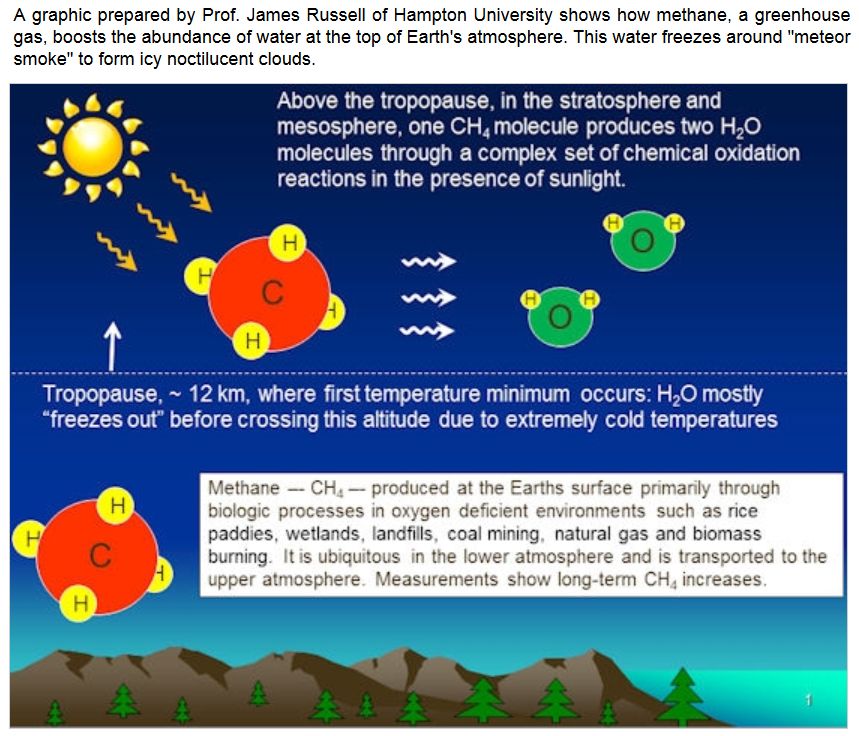
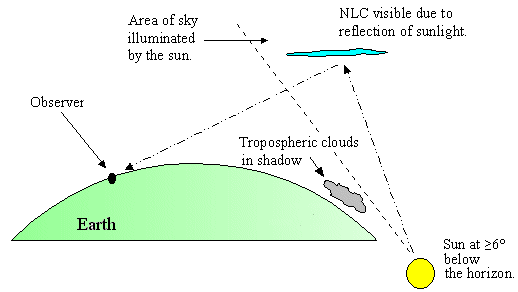
Observing tips: Look west 30 to 60 minutes after sunset when the Sun has dipped 6o to 16o below the horizon. If you see luminous blue-white tendrils spreading across the sky, you may have spotted a noctilucent cloud.
Realtime Noctilucent Cloud Photo Gallery