A METEOR SHOWER IN BROAD DAYLIGHT: The annual Arietid meteor shower peaks this week on June 7th and 8th. The Arietids are unusual because they are daytime meteors; the shower is most intense after sunrise. People who wake up early might notice a small number of Arietids during the dark hours before dawn. The real action, however, occurs in broad daylight. Tune into the meteor radar for echoes.
SOUTHERN LIGHTS: On June 5th and 6th, a stream of solar wind buffeted Earth's magnetic field, sparking bright auroras. Although the lights danced in equal measure around both of Earth's poles, they were best seen in the southern hemisphere. "It is getting frosty, cold, and dark as winter approaches," says Taichi Nakamura of Dunedin NZ. "This allowed us to see a strong display in the south of New Zealand." He took this picture on June 6th:
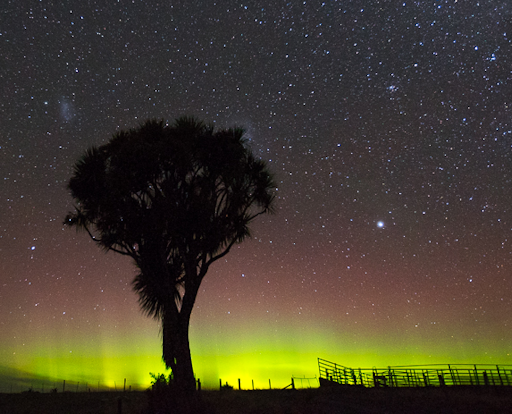
Some readers have been asking, how can we have such strong auroras without sunspots? Answer: Sunspots are not required. These auroras were sparked by a stream of solar wind fire-hosing out of a coronal hole in the sun's atmosphere. Such holes can form even when sunspots are completely absent. Indeed, there is one opening up right now. An emerging stream of solar wind could reach Earth as early as June 11-12, kickstarting a new display of Southern Lights. Stay tuned. Aurora alerts: text, voice.

WHEN A RAINBOW IS NOT A RAINBOW: We've all seen rainbows. But have you ever seen a rainbow of fire? Cata Alonso Castro photographed one over Pine Lake, California, on June 5th:

"I thought the lake, trees, and mountains were wonderful, but when I saw that rainbow in the clouds I just couldn't believe my eyes," says Cata.
The correct name of this phenomenon is circumhorizon arc. It's a colorful splash of light caused by sunbeams striking crystals of ice in cirrus clouds. Commonly called "fire rainbows" or "rainbows of fire," circumhorizon arcs have nothing to do with either rain or fire. They are a sign of ice floating in clouds some 10 km above the ground.
Summer is the season for circumhorizontal arcs because they appear only when the sun is high in the sky--more than 58o above the horizon. The arc's enormous size and pure spectral colors make it one of the most beautiful of all ice halos.
Realtime Space Weather Photo Gallery
SPACE BALLS FOR FATHER'S DAY (JUNE 19th): What do you give the Father who has everything? Space Balls! A few days ago, the students of Earth to Sky Calculus flew a basket of space-helmeted golf balls to the edge of space, 36.3 km (119,000 feet) above Earth's surface on board a high altitude helium balloon:
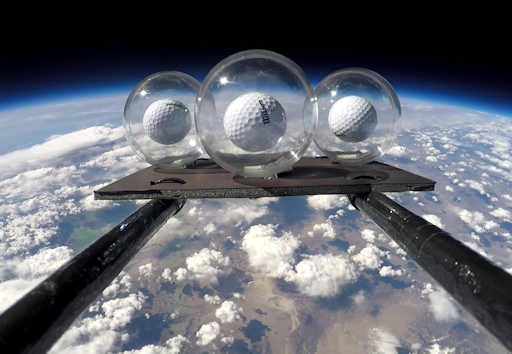
After the balloon exploded, the balls parachuted back to Earth, landing in the volcanic tablelands north of Bishop CA. For $49.95 you can have one of these balls (space helmet included) along with a unique Father's Day card showing the balls floating at the top of Earth's atmosphere. The interior of the card tells the story of the flight and confirms that this gift has been to the edge of space and back again.
All sales support student space weather research. In fact, the balls pictured above were hitchhiking on a payload equipped with radiation sensors. We send the sensors to the stratosphere every week to monitor increasing levels of cosmic rays. Visit the Earth to Sky store to support this crowd-funded research.
Realtime Space Weather Photo Gallery
Realtime Noctilucent Cloud Photo Gallery