A METEOR SHOWER IN BROAD DAYLIGHT: The annual Arietid meteor shower peaks this week on June 7th and 8th. The Arietids are unusual because they are daytime meteors; the shower is most intense after sunrise. People who wake up early might notice a small number of Arietids during the dark hours before dawn. The real action, however, occurs in broad daylight. Tune into the meteor radar for echoes.
RETURN OF THE SUNSPOT: It's not much, but it is a sunspot. Breaking a string of 4 consecutive spotless days, tiny AR2552 emerged in the sun's northern hemisphere on June 7th. It is the speck circled in this image from NASA's Solar Dynamics Observatory:

The sunspot's primary dark core is not much wider than the Moon, and it has a simple, stable magnetic field that poses little threat for explosions. Indeed, NOAA forecasters say there is no more than a 1% chance of strong flares for the next three days. Solar activity should remain very low for the rest of the week.
Realtime Space Weather Photo Gallery
GREEN LIGHTS OVER TEXAS: On June 6th during a G1-class geomagnetic storm, the dark starry sky above Big Bend National Park in Texas turned green. It was not, however, the aurora borealis. Scroll past this picture of the phenomenon, taken by James and Karen Young, for an explanation:

"It's airglow," says Young. "We noticed it around 3 a.m. and it was quite bright."
Airglow is an faint bubble of everpresent light that surounds our entire planet, fringing the top of the atmosphere with aurora-like color. Although airglow resembles the aurora borealis, its underlying physics is different. Airglow is caused by an assortment of chemical reactions in the upper atmosphere driven mainly by solar ultraviolet radiation. Auroras, on the other hand, are caused by gusts of solar wind.
Green airglow is best photographed from extremely dark sites on nights when the Moon is new or below the horizon. It often shows up in long exposures of the Milky Way. Indeed, you can see the Milky Way and the Androdeda Galaxy in Young's photo, a 20 second exposure at ISO 6400.
For more views of airglow, browse the gallery.
Realtime Airglow Photo Gallery
SPACE BALLS FOR FATHER'S DAY (JUNE 19th): What do you give the Father who has everything? Space Balls! A few days ago, the students of Earth to Sky Calculus flew a basket of space-helmeted golf balls to the edge of space, 36.3 km (119,000 feet) above Earth's surface on board a high altitude helium balloon:
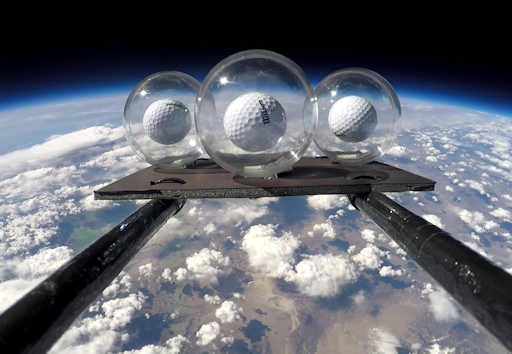
After the balloon exploded, the balls parachuted back to Earth, landing in the volcanic tablelands north of Bishop CA. For $49.95 you can have one of these balls (space helmet included) along with a unique Father's Day card showing the balls floating at the top of Earth's atmosphere. The interior of the card tells the story of the flight and confirms that this gift has been to the edge of space and back again.
All sales support student space weather research. In fact, the balls pictured above were hitchhiking on a payload equipped with radiation sensors. We send the sensors to the stratosphere every week to monitor increasing levels of cosmic rays. Visit the Earth to Sky store to support this crowd-funded research.
Realtime Noctilucent Cloud Photo Gallery