GEOMAGNETIC ACTIVITY: Arriving earlier than expected, a co-rotating interaction region (CIR) hit Earth's magnetic field on June 14-15, sparking a brief but potent geomagnetic storm (G2-class). CIRs are transition zones between slow- and fast-moving solar wind streams. Plasma density gradients in CIRs often do a good job sparking auroras. This time, however, no lights were reported. Aurora alerts: text or voice

ICE HALOS REFUSE TO MELT: As summer unfolds across the northern hemisphere, ice and snow are an increasingly distant memory. It's still freezing, however, in the clouds. Ice crystals floating miles above Earth's surface caused this display in Sweden:

"This 22° halo appeared yesterday here in Kiruna," says photographer Mia Stålnacke. "It was beautiful!"
Ice in the clouds can bend sunlight in many interesting ways, forming luminous rings, arcs, and pillars. Collectively these are known as "ice halos." They may be seen around the world during all four seasons--even summer--because it is always freezing miles overhead. Look for them whenever the sun is up and the blue sky is criss-crossed by icy cirrus clouds.
More examples may be found in the realtime photo gallery:
Realtime Space Weather Photo Gallery
NOCTILUCENT OUTBURST: On June 13th, observers in more than half a dozen European countries witnessed a brilliant apparition of noctilucent clouds. Ruslan Merzlyakov sends this picture from Nykøbing Mors, Denmark:

"Their brightness peaked from 00:50 to 1:20 and then, suddenly, they were almost gone," says Merzlyakov, who recorded a video of the display.
Noctilucent clouds are a space weather phenomenon. They are seeded by meteoroids and hover 83 km above Earth's surface at the threshold of space. Summer is the season for NLCs because, ironically, that is when the upper atmosphere is cold enough for ice crystals to form around meteoroids in the mesosphere.
Noctilucent clouds were first reported by Europeans in the late 1800s. In those days, you had to travel to latitudes well above 50o to see them. Now, however, NLCs are spreading. In recent years they have been sighted as far south as Colorado and Utah in the United States. Many researchers suspect this is a side-effect of climate change.
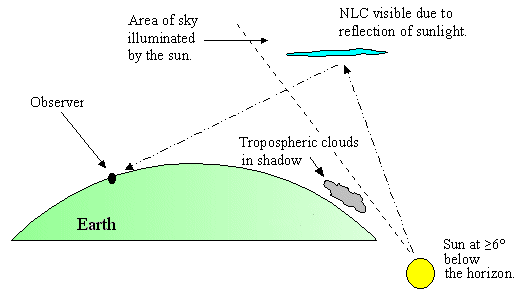
Observing tips: Look west 30 to 60 minutes after sunset when the Sun has dipped 6o to 16o below the horizon (diagram). If you see blue-white tendrils spreading across the sky, you may have spotted a noctilucent cloud.
Realtime Noctilucent Cloud Photo Gallery
DONUT OF LIGHT OVER COLORADO: On June 8th, high above a thunderstorm in Colorado, an enormous ring of light appeared near the edge of space. Amateur astronomer Thomas Ashcraft photographed the 'donut' using a low-light video camera.

"It only lasted about a millisecond," says Ashcraft, "but it was definitely there. The ring was about 300 km wide," he estimates.
This is an example of an ELVE (Emissions of Light and Very Low Frequency Perturbations due to Electromagnetic Pulse Sources). First seen by cameras on the space shuttle in 1990, ELVEs appear when a pulse of electromagnetic radiation from lightning propagates up toward space and hits the base of Earth's ionosphere. A faint ring of light marks the broad 'spot' where the EMP hits.
ELVES often appear alongside red sprites. Indeed, Ashcraft's camera caught a cluster of sprites leaping straight up through the middle of the donut. "Play the complete video to see the sprites," says Ashcraft.
ELVEs are elusive--and that's an understatement. Blinking in and out of existance in only 1/1000th of a second, they are completely invisible to the human eye. For comparison, red sprites tend to last for hundredths of a second and regular lightning can scintillate for a second or more. Their brevity explains why ELVEs are a more recent discovery than other lightning-related phenomenon.
Learn more about the history and physics of ELVEs here and here.