NO FLARES FOR FATHER'S DAY: With no sunspots actively flaring, solar activity is very low. This situation is likely to continue throughout the weekend. NOAA forecasters say there is no more than a 1% chance of strong flares on June 19th. Solar flare alerts: text or voice
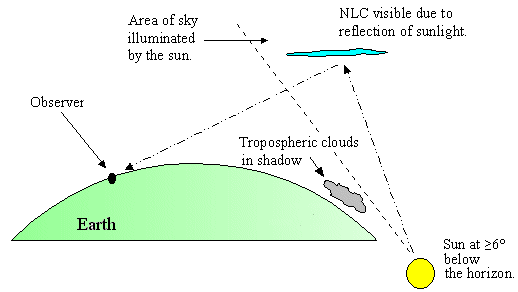
NOCTILUCENT CLOUDS REACH NORTH AMERICA: The 2016 summer season for noctilucent clouds is underway. So far, however, the clouds have been sighted almost exclusively in Europe. Last night, finally, a bright display appeared over North America. Harlan Thomas sends this picture from Calgary, Alberta:

"The AIM daisy on Spaceweather.com showed a high concentration of NLCs over North America," says Thomas. "Yay! I thought to myself, let's get out there and see whats up. As I waited the coyotes howled and the owls hooted. Fighting the waxing gibbious Moon, the NLCs began to appear in the WNW sky--a lovely sight almost a year in the waiting."
Noctilucent clouds are a true space weather phenomenon.They form at the edge of space, ~83 km above Earth's surface, when diaphanous wisps of water vapor wrap themselves around meteoroids to form tiny ice crystals. Long ago, they were confined to Arctic latitudes. As a result of climate change, they are now brightening and spreading, with sightings in recent years as far south as Colorado and Utah.
Observing tips: Look west 30 to 60 minutes after sunset when the sun has dipped 6o to 16o below the horizon. If you see luminous blue-white tendrils spreading across the sky, you may have spotted a noctilucent cloud.
Realtime Noctilucent Cloud Photo Gallery
POLAR STRATOSPHERIC CLOUDS: Bright colors have appeared in the skies over Antarctica--but it's not the aurora australis. Instead, pastel stratospheric clouds are floating over the frozen continent. B. Sudarsan Patro photographed the apparition on June 17th from the Bharati Indian Base Station:

"The clouds were absolutely stunning," says Patro. "It was really surprising and a new experience for all of us."
Atmospheric optics expert Les Cowley says "Bharati Station at 70 degrees south is just the place to get these wonderful filmy Polar Stratospheric Clouds (PSCs). Floating 9 to 16 miles high, they need stunningly-cold temperatures below -85 Celsius to form."
Sunlight shining through tiny ice particles ~10µm across produce the characteristic bright iridescent colors of PSCs by diffraction and interference. "More familiar tropospheric clouds can also shine with iridescent colours," says Cowley, "but never as vividly or memorably as PSCs. This page helps distinguish the two."
Realtime Space Weather Photo Gallery
RED SPRITES AND GREEN AIRGLOW: Thunderstorm season is underway in the northern hemisphere. That means astrophotographers should point their cameras above the clouds. Thomas Ashcraft did so on June 14th, and he captured two forms of space weather--red sprites and green airglow:

"A large jellyfish sprite appeared over a thunderstorm in the western Oklahoma panhandle last evening," says Ashcraft. "It was about three hundred miles away from my observatory."
"I also caught it in video with very low frequency (VLF) radio emissions, and the parent lightning stroke made a strong pop," he says. Turn up the volume and play the video.
Possibly triggered by cosmic rays, sprites are a form of upper atmospheric that reach up from the tops of thunderstorms toward the edge of space. Although sprites have been seen for at least a century, most scientists did not believe they existed until after 1989 when sprites were photographed by cameras onboard the space shuttle.
The "jellyfish sprite" Ashcraft captured is backlit by a band of green airglow. Airglow surrounds our entire planet, fringing the top of the atmosphere with aurora-like color. Although airglow resembles the aurora borealis, its underlying physics is different. Airglow is caused by an assortment of chemical reactions in the upper atmosphere. Auroras, on the other hand, are ignited by gusts of solar wind.