ALMOST NO CHANCE OF FLARES: NOAA forecasters say the chance of a strong solar flare today is no more than 1%. Solar activity is low and likely to remain so for the rest of the week. Solar flare alerts: text, voice.
MIDNIGHT SUN AND MOON: Imagine seeing the sun and the full Moon ... simultaneously ... at the stroke of midnight ... on the summer solstice. It happened last night inside the Arctic Circle. Göran Strand photographed them both on June 21st from Gällivare, Sweden:

"Seeing the Midnight Sun is really special," says Strand. "After I photographed the sun, I turned around and there was the Moon, too! It was quite awesome to be able to see both the sun and the full Moon during the night."
This is a coincidence that doesn't happen often. It's been decades since the full Moon fell on the night of the solstice, joining the sun as a midnight herald of summer. Strand was in the right place at the right time for a truly unique moonshot. Browse the gallery for more.
Realtime Space Weather Photo Gallery
DODGING CMEs: A bright CME (coronal mass ejection) billowed away from the sun's northeastern limb during the late hours of June 20th. Click to watch the nearly-transparent plasma cloud pass in front of Venus:

This CME will not hit Earth. It came from an active region (probably an unstable sunspot) on the farside of the sun. As long as that sunspot remains on the farside, its explosions will not affect our planet. Earth-directed solar activity remains low.
Realtime Space Weather Photo Gallery
ELECTRIC BLUE SUNSETS: Northern summer has begun. That means it's time for picnics, hot dogs, dips in the pool, and ... oh yes ... electric blue sunsets. Summer is the season for noctilucent clouds (NLCs), and reports of their telltale blue ripples are pouring in from Canada, Alaska and many countries in Europe. Marek Nikodem sends this picture from Żnin Lake, near Szubin, Poland:

"Last night, I watched a fantastic display of NLCs," says Nikodem. "Before midnight the clouds were low on the horizon. After midnight a great complex sprung up, as wide as 100 degrees. It was absolutely beautiful."
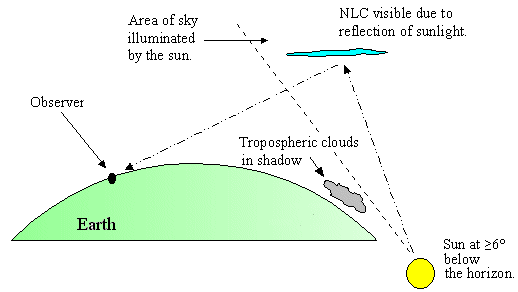
Noctilucent clouds are a true space weather phenomenon. They assemble at the edge of space, ~83 km above Earth's surface, when diaphanous wisps of water vapor wrap themselves around meteoroids to form tiny ice crystals. Long ago, they were confined to Arctic latitudes. As a result of climate change, they are now brightening and spreading, with sightings in recent years as far south as Colorado and Utah.
Observing tips: Look west 30 to 60 minutes after sunset when the sun has dipped 6o to 16o below the horizon. If you see luminous blue-white tendrils spreading across the sky, you may have spotted a noctilucent cloud.
Realtime Noctilucent Cloud Photo Gallery
POLAR STRATOSPHERIC CLOUDS: Bright colors have appeared in the skies over Antarctica--but it's not the aurora australis. Instead, pastel stratospheric clouds are floating over the frozen continent. B. Sudarsan Patro photographed the apparition on June 17th from the Bharati Indian Base Station:

"The clouds were absolutely stunning," says Patro. "It was really surprising and a new experience for all of us."
Atmospheric optics expert Les Cowley says "Bharati Station at 70 degrees south is just the place to get these wonderful filmy Polar Stratospheric Clouds (PSCs). Floating 9 to 16 miles high, they need stunningly-cold temperatures below -85 Celsius to form."
Sunlight shining through tiny ice particles ~10µm across produce the characteristic bright iridescent colors of PSCs by diffraction and interference. "More familiar tropospheric clouds can also shine with iridescent colours," says Cowley, "but never as vividly or memorably as PSCs. This page helps distinguish the two."