SPECIAL WEBCAST: Ever wondered how NASA plans to fly astronauts to Mars? You can find out on June 24th, when the Coca-Cola Space Science Center visits Cape Canaveral for a live webcast about NASA's new Space Launch System. Friday's webcast will include the bone-rattling launch of a mighty Atlas V rocket. The action begins at 7 am EDT. Tune in here!
SUNSPOTS VANISHING, AGAIN: For the second time this month, the solar disk is blank--no sunspots. This image of the sun taken by NASA's Solar Dynamics Observatory on June 23rd shows zero dark cores:

What does this mean? The solar cycle is like a pendulum, swinging back and forth between periods of high and low sunspot number every 11 years. Today's blank sun is a sign that the pendulum is swinging toward low sunspot numbers. In other words, Solar Minimum is coming.
Forecasters expect the next Solar Minimum to arrive in 2019-2020. Between now and then, there will be lots of spotless suns. At first, the blank stretches will be measured in days; later in weeks and months. When the sunspot cycle reaches its nadir, a whole year could go by without sunspots.
However, don't expect space weather to go away. Solar Minimum brings many interesting changes. For instance, as the extreme ultraviolet output of the sun decreases, the upper atmosphere of Earth cools and collapses. This allows space junk to accumulate around our planet. Also, the heliosphere shrinks, bringing interstellar space closer to Earth. Galactic cosmic rays penetrate the inner solar system--and Earth--with relative ease.
Indeed, a cosmic ray surge is already underway . Cosmic rays can seed clouds, trigger lightning, and penetrate commercial airplanes. Our measurements show that someone flying back and forth across the continental USA, just once, can absorb as much ionizing radiation as 2 to 5 dental X-rays. This exposure will increase as Solar Minimum deepens.
Realtime Space Weather Photo Gallery
MIDNIGHT SUN AND MOON: Imagine seeing the sun and the full Moon ... simultaneously ... at the stroke of midnight ... on the summer solstice. It happened last night inside the Arctic Circle. Göran Strand photographed them both on June 21st from Gällivare, Sweden:

"Seeing the Midnight Sun is really special," says Strand. "After I photographed the sun, I turned around and there was the Moon, too! It was quite awesome to be able to see both the sun and the full Moon during the night."
This is a coincidence that doesn't happen often. It's been decades since the full Moon fell on the night of the solstice, joining the sun as a midnight herald of summer. Strand was in the right place at the right time for a truly unique moonshot. Browse the gallery for more.
NOCTILUCENT CLOUDS IN MOTION: On June 21st, the first night of summer, a fantastic display of noctilucent clouds (NLCs) appeared over Alberta, Canada. "They were the brightest I have ever seen," reports photographer Derek Mellott from the town of Gibbons. "It seemed like a good time to record a time lapse." Click on the arrow to set the scene in motion:

Mellott's video shows the almost hypnotic motions of the cloud's finely-structured ripples. "It was amazing," he says. Indeed, no other kind of cloud moves like an NLC, which twists and turns in the unique winds at the edge of space.
Noctilucent clouds are a true space weather phenomenon. They assemble more than 80 km above Earth's surface where diaphanous wisps of summertime water vapor wrap themselves around meteoroids to form tiny ice crystals. Long ago, they were confined to Arctic latitudes. As a result of climate change, they are now brightening and spreading, with sightings in recent years as far south as Colorado and Kansas.
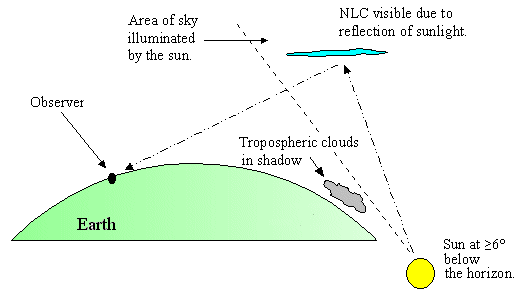
Observing tips: Look west 30 to 60 minutes after sunset when the sun has dipped 6o to 16o below the horizon. If you see luminous blue-white tendrils spreading across the sky, you may have spotted a noctilucent cloud.
Realtime Noctilucent Cloud Photo Gallery